
Last updated October 16, 2026
Insulation Warning Signs: A Orange County Homeowner’s Reference Guide
If your second floor is consistently 6 to 8 degrees hotter than your first floor in summer, your insulation isn’t the first thing most homeowners suspect. It should be. That temperature split is the most reliable early indicator of attic insulation failure in a two-story Orange County home. In our experience across Orange County, by the time a homeowner notices a $400 energy bill, the attic has been signaling trouble for months. Those signals just don’t happen in the attic. They happen in bedrooms, hallways, closets, and even outside along the roofline. This guide maps what you’re already noticing inside your home back to the specific attic conditions causing it, so you can catch insulation failure before it becomes a budget problem. For a deeper dive, see our Complete Guide to Insulation in Orange County.
Quick Answer
The most common insulation warning signs in Orange County homes are a persistent 6 to 8 degree temperature difference between floors, a master bedroom that won’t hold its temperature at night, energy bills that spike in September rather than July, musty odors in upstairs closets, and daylight visible through attic soffit vents from outside. Any two of these together usually mean your attic insulation has been compressed, displaced, or compromised by moisture and needs a professional evaluation. Our Attic Insulation Maintenance Checklist for Orange County Homeowners can help you track these signs over time.
Table of Contents
- The Temperature Differential Test: Mapping the Problem Room by Room
- Why Your Energy Bill Spikes in September, Not July
- Three Exterior Warning Signs Visible From the Street
- What a Musty Bedroom Closet Is Actually Telling You
- Planned Repairs vs. Immediate Calls: Which Warning Sign You’re Looking At
- The Attic Conditions Behind the Symptoms
- Common Mistakes to Avoid
- When to Call a Professional
- Frequently Asked Questions
- The Bottom Line
The Temperature Differential Test: Mapping the Problem Room by Room
Most Orange County homeowners accept that their upstairs runs warmer than downstairs. What they don’t realize is that the size of that gap is diagnostic. A well-insulated two-story home in Orange County should hold a temperature difference between floors of 2 to 4 degrees. Anything beyond 5 degrees, sustained through the afternoon and evening, points almost directly at the attic.
Here’s why: heat doesn’t rise through your home in equal amounts. It moves toward the path of least resistance. Your attic insulation is a single, continuous barrier between your living space and the hottest part of the house. When sections of that barrier are missing, compressed, or displaced, the heat enters unevenly. The rooms directly beneath the compromised sections warm faster and stay warmer longer. The rooms beneath intact insulation don’t.
That’s where the $15 infrared thermometer comes in. You don’t need a thermal camera or an energy audit to map the problem. You need an afternoon, a notebook, and the willingness to walk your own home like a technician would.
The Step-by-Step Temperature Mapping Process
- Wait for a clear afternoon. You want a day when the sun is fully exposed and the outdoor temperature is at least 80 degrees. Orange County’s inland valleys regularly hit this from June through October, even when coastal areas stay cooler.
- Close all windows and run the AC as you normally would. Set the thermostat to 74 or 75 degrees. Let the system run for at least two hours before you start measuring. You’re testing how well the house holds that temperature, not how quickly it cools.
- Measure the air temperature in each room, at chest height, in the center. Write down the reading and the room name. Don’t measure near windows, doors, or supply vents. Those spots give you false readings.
- Measure the ceiling temperature in each room. Point the infrared thermometer at the ceiling in the center of the room. Hold it about 12 inches away. Record the reading. Do this for every upstairs room, plus the rooms directly below them on the first floor.
- Compare your ceiling readings to your air readings. In a properly insulated room, the ceiling should be within 3 degrees of the room’s air temperature. A ceiling that runs 6, 8, or 10 degrees warmer than the air below it tells you the attic insulation directly above that room is failing, even if you can’t see it from the attic itself.
- Map the hot zones. Circle the rooms where the ceiling-to-air gap exceeds 5 degrees. Then, if you can safely access the attic, look at what’s directly above those rooms. In our experience, the correlation is almost always exact: the hot spots line up with batts that have shifted out of place, loose fill that has settled to a fraction of its original depth, or areas where insulation was never properly installed around can lights, bathroom fans, and duct runs.
Note: don’t do the ceiling measurement on a day when the attic has been hot for only an hour. Give the heat time to soak through. A mid-afternoon reading on a hot day is when the contrast shows up most clearly. In coastal Orange County areas like Huntington Beach or Newport Beach, you may need a warmer-than-average day for this test to be conclusive. In inland areas like Anaheim, Orange, or Fullerton, most summer afternoons work.
Why Your Energy Bill Spikes in September, Not July
Most homeowners in Orange County assume their highest energy bill arrives in July, when temperatures peak. But in many homes with failing attic insulation, the worst bill hits in September and October instead. That counterintuitive pattern is one of the most useful diagnostic clues in the trade, and almost no one outside the industry talks about it. We cover why this happens seasonally in our Seasonal Insulation Care for Orange County: Year-Round Homeowner’s Guide.
Here’s what’s actually happening. During July and August, your air conditioner runs hard during the day, but the heat it battles has a hard time penetrating deep into the attic insulation. The insulation, even in poor condition, absorbs and holds some of that heat. At night, when outdoor temperatures in Orange County drop into the 60s, that stored heat radiates back out through the roof. The cycle resets each morning.
The problem comes in September. By then, we’ve had weeks of sustained high temperatures. The thermal mass of your attic isn’t recovering overnight anymore. The insulation, if it’s compressed or moisture-logged, has effectively given up its ability to slow heat transfer. The ceiling cavity above your bedrooms is now radiating heat downward around the clock. Your AC runs longer at night than it did in July, even though the outdoor temperature is more moderate. The bill reflects that night-time workload.
A September or October energy bill that matches or exceeds your July bill, without an obvious change in your household’s usage, is a strong signal of attic insulation in Orange County failure. It’s specifically the insulation, not the HVAC system, because an HVAC efficiency problem would show up consistently all summer. The late-season pattern is insulation compression. Compressed fiberglass or cellulose loses its air pockets, and those air pockets are what do the insulating. Once they’re gone, the material is just a dense mat that transfers heat efficiently. That’s not a gradual decline. It’s a threshold event, and it usually happens after enough hot seasons have baked the material.
Three Exterior Warning Signs Visible From the Street
You don’t have to go into the attic to spot insulation problems. Three warning signs are visible from the outside of your Orange County home, and most people walk past them every day without knowing what they’re looking at.
1. Blocked Soffit Vents With Visible Daylight
Stand at the corner of your house and look up along the roofline. The underside of the overhang, the part that faces the ground, has a line of small openings called soffit vents. In a functioning attic, those vents allow air to enter from below, rise through the attic, and exit through vents near the roof peak. That continuous airflow is what keeps attic temperatures manageable and prevents moisture buildup.
In many Orange County homes, however, blown-in or batt insulation has been shoved too deep into the eaves during installation. The insulation blocks the soffit vents entirely. The result is an attic that can’t breathe. Heat and moisture build up, and the insulation that was supposed to protect your home becomes a damp, inefficient blanket. From outside, you may see insulation fibers poking out through the vent openings, or the vents may look dark and clogged when they should show daylight.
If you can see through your soffit vents from the outside (a ladder and a flashlight help), they’re clear. If they’re blocked, the airflow in your attic is compromised, and that’s a problem regardless of how much insulation is up there.
2. Staining on Fascia Boards
The fascia boards run along the roofline, just behind the gutters. They’re the vertical boards the gutters are mounted to. When insulation fails and attic moisture builds, that moisture condenses and runs down the roof deck, eventually reaching the fascia. The boards swell, discolor, and develop water stains. In Orange County’s Mediterranean climate, where rain is rare but morning fog is common near the coast, this condensation can happen even without roof leaks. Homes in Santa Ana, Tustin, and Irvine, where summer mornings bring heavy marine layer moisture, are particularly prone to it.
Stained or warped fascia means the attic has a moisture management problem. The insulation is likely involved, either because it’s blocking the ventilation that would otherwise dry the attic, or because it’s wet and transferring moisture to the roof decking. Either way, it’s a signal that something above your ceiling isn’t working right.
3. Animal Entry Points Near the Roofline
Orange County has a substantial squirrel, rat, and bird population, and attics are their preferred territory. If you notice gaps, chewed edges, or nesting material visible near the roofline, animals have been entering your attic. Why does that matter for insulation? Because once animals establish themselves, they destroy insulation quickly. They tunnel through blown-in material, shred batts for nesting, and contaminate what remains with urine and droppings. A single squirrel family can ruin the insulation over two or three rooms in a matter of weeks.
The presence of animal activity near the roofline is a warning sign that your insulation has already been, or is about to be, compromised. And here’s the part most homeowners don’t realize: even after the animals are removed, the insulation they destroyed is still doing nothing. The damage doesn’t repair itself. You have to replace the affected material.
What a Musty Bedroom Closet Is Actually Telling You
A musty smell in an upstairs bedroom closet is one of the most commonly misdiagnosed problems in Orange County homes. Homeowners smell it and assume plumbing. But in a two-story house, the bathroom plumbing rarely runs through bedroom closets on an exterior wall. More often, that smell is coming from the attic above the closet, and it’s telling you something specific about insulation and vapor management.
Here’s what happens. Closets often sit at the corners of rooms, which are also the corners of the attic. Those corners are where insulation is most likely to be thin, absent, or packed against the roof deck in a way that blocks airflow. When warm, moisture-laden air from the house rises into the attic and meets a cool surface, it condenses. If the insulation in that corner is wet or if there’s no proper air sealing between the living space and the attic, the condensation soaks into the insulation and the framing.
That damp insulation is what you’re smelling. It’s not a plumbing smell, and it’s not coming from inside the closet. It’s coming from directly above it. The difference matters, because the fix is completely different. If it were plumbing, you’d call a plumber. Since it’s insulation and vapor management, you need an insulation professional to inspect the attic cavity above the closet, check the depth and condition of the material, verify that the soffit and ridge vents are clear, and air-seal the penetrations that are letting conditioned air escape into the attic in the first place.
Here’s the Orange County-specific part: our climate makes this worse than homeowners expect. Inland temperatures drive heavy air conditioning use, and conditioned air holds more moisture than people realize. That moisture is being pushed up through the ceiling assembly at every gap around light fixtures, fan housings, and drywall seams. Coastal areas, with their persistent morning fog, add moisture from outside. The result is that attic corners in Orange County homes are far more likely to harbor damp insulation than homeowners assume, even in houses without roof leaks.
If you’ve got a musty closet smell that comes and goes with the seasons, or gets stronger when the AC runs hard, that’s an attic ventilation and insulation signal. Don’t wait for it to turn into visible staining on the ceiling.
Planned Repairs vs. Immediate Calls: Which Warning Sign You’re Looking At
Not every insulation warning sign requires you to drop everything and call someone today. Some allow you to plan, budget, and schedule the work on your terms. Two signs, though, should trigger an immediate inspection call. Here’s the difference.
Signs That Allow a Planned Repair Window
- A 5 to 8 degree temperature differential between floors that has developed gradually over several seasons. This is insulation that’s settled or shifted. It’s failing, but it’s failing slowly. You can take a few weeks to get quotes and compare options.
- A September energy bill that’s 15 to 20 percent higher than expected. Again, this is a gradual decline. It’s expensive, but not dangerous.
- Blocked soffit vents with no other moisture symptoms. The airflow is restricted, but if you’re not seeing staining or smelling must, you have time to get it corrected before the problem compounds.
- General thinness in the attic insulation. Many older Orange County homes were built with R-19 or less when today’s recommended level for our climate zone is R-38 to R-49. If you’re just realizing your insulation is underbuilt, that’s a planning conversation, not an emergency.
The Two Signs That Require an Immediate Call
- Active moisture in the attic. If you see visible water staining on the underside of the roof deck, wet insulation, or dripping around vents and ductwork, that’s an active problem. Every day it continues, the damage compounds. Wet insulation holds almost no R-value, and moisture is soaking into the framing. This needs to be inspected now.
- Animal activity in the attic. Squirrels, rats, and birds don’t take breaks. They’re actively destroying insulation, chewing wiring, and contaminating the space while you wait. If you hear movement in the attic or see animal entry points near the roofline, call for an inspection immediately. The insulation replacement can be scheduled after the animals are removed, but the inspection needs to happen now to assess the extent of the damage.
For everything else, there’s room to breathe. We recommend going through the temperature mapping process, walking the exterior of your home, and coming to the conversation with specific observations. You’ll find more guides & resources on our blog to help you prepare. A homeowner who can say “the ceiling in my daughter’s bedroom reads 9 degrees warmer than the room air” is a homeowner who’s going to get a more precise diagnostic from any contractor they call.
The Attic Conditions Behind the Symptoms
Everything you notice inside your home has a physical counterpart in the attic. Understanding that link helps you evaluate what a contractor tells you and gives you confidence that the fix being proposed actually addresses the root cause.
Settled or Compressed Blown-In Insulation
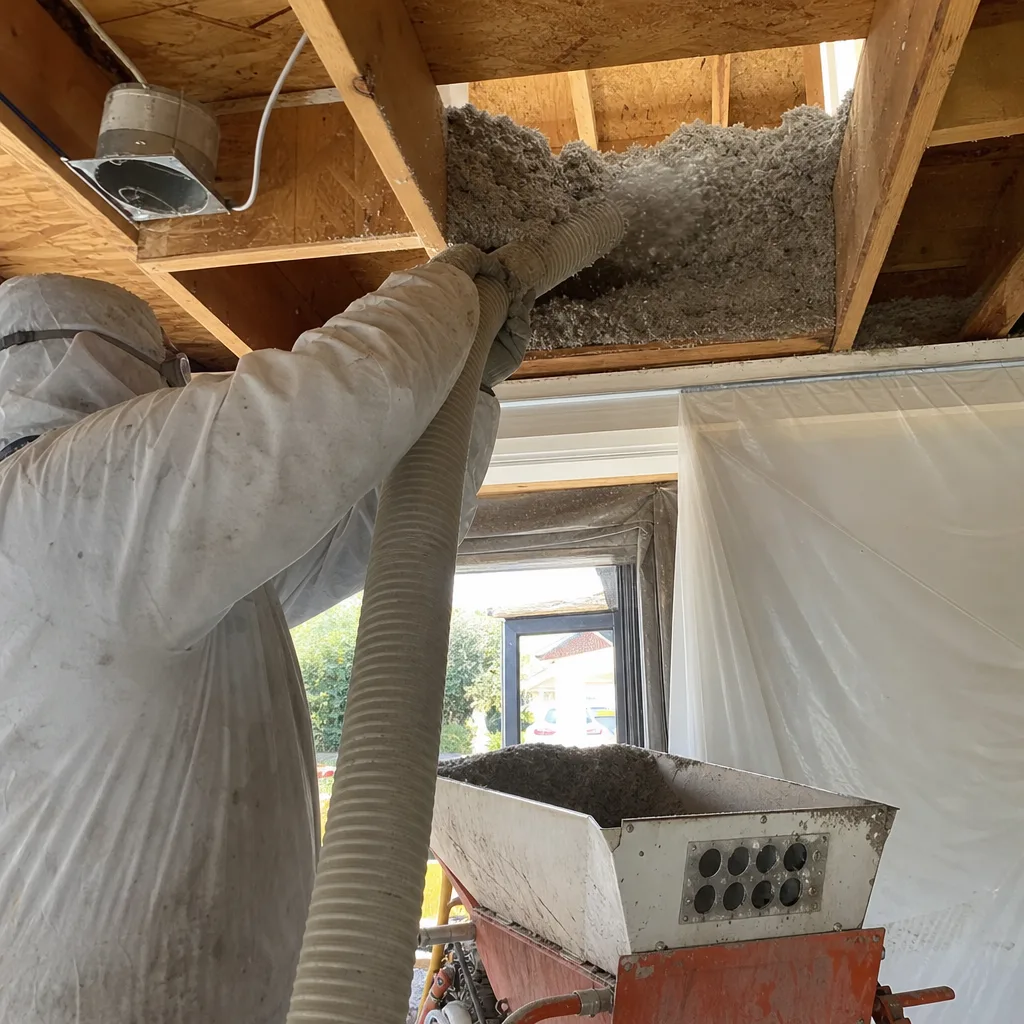
Blown-in insulation (loose fibers blown into the attic cavity to fill every gap) doesn’t stay where it’s put forever. Over years of thermal cycling, it settles. What was once 14 inches of fluffy R-38 may now be 6 or 7 inches of denser material performing at R-19 or less. The settling isn’t uniform, which is why you get hot spots in some rooms and not others. Blown in insulation in Orange County homes tends to settle most in areas where attic access is frequent, where ductwork runs through the material, and where previous contractors walked during other work.
Displaced Batts
Batt insulation comes in pre-cut lengths designed to fit between standard joist spacing. But batts get moved. Electricians move them to run wire. Cable installers move them to pull coax. HVAC techs move them to service duct runs. In most cases, the batts don’t get put back. They end up bunched against the roofline or stacked in one corner, leaving bare ceiling joists exposed over living space. That bare section is an uninsulated hole in your thermal envelope. We see this in attics across Orange County, in homes built from Santa Ana to Mission Viejo, and the result is always the same: a warm ceiling, a hot room, and a homeowner who can’t figure out why.
Air Leakage Through Ceiling Penetrations
Even perfect insulation can’t do its job if conditioned air is leaking out of your living space through gaps around can lights, bathroom fans, and attic access hatches. Those gaps are pressure leaks. Your AC creates positive pressure in the living space, and that pressure pushes air up through every crack and penetration into the attic. The insulation slows heat transfer, but it doesn’t slow air movement much at all. In many Orange County homes, air leakage accounts for as much energy loss as the insulation deficiency itself. That’s why proper air sealing, not just adding material, is the fix that actually works.
Moisture-Soaked Material
Insulation that’s wet is insulation that’s not working. Fiberglass and cellulose both lose their insulating ability when damp. The water fills the air pockets that provide the thermal resistance. Add to that the fact that wet insulation stays wet in a poorly ventilated attic, and you have a compounding problem. In coastal Orange County areas like Costa Mesa and Huntington Beach, morning marine layer moisture can keep an attic humid for weeks at a time, even without a roof leak. The insulation acts like a sponge, holding that moisture against the roof deck and framing.
Our approach at Aspen Attic Insulation Orange County home starts with a full attic inspection that documents what’s actually in the attic, where it’s failing, and why. We bring materials from brands like Owens Corning, Johns Manville, Knauf, Rockwool, CertainTeed, Icynene, Demilec, and GreenFiber, matching the product to the specific problem rather than installing whatever happens to be on the truck. The right material for a moisture-prone coastal attic is different from the right material for a dry inland attic, and the difference matters over the life of the insulation.
Common Mistakes to Avoid
Over the years, we’ve seen Orange County homeowners make the same set of mistakes when responding to insulation warning signs. Each mistake costs money and delays the actual fix. Here are the seven most common, and what to do instead.
- Adding insulation on top of wet insulation. This is the most expensive mistake a homeowner can make. Burying moisture doesn’t solve it. It traps it against the existing material and framing, and the new insulation gets wet too. Fix the moisture first, then insulate.
- Treating the symptom instead of the attic. Buying a window AC unit for a hot upstairs bedroom treats the symptom. The problem is still in the attic. Sealing and insulating the attic fixes the bedroom and every other room at the same time.
- Assuming the insulation is fine because it’s thick enough. Thickness doesn’t equal insulation if the material is compressed, settled, or wet. The only reliable check is a professional measurement of actual R-value, not a visual guess.
- Ignoring the air leakage problem. Many homeowners add insulation and wonder why their bill didn’t drop much. Without air sealing around ceiling penetrations, the conditioned air keeps leaking out. The insulation and the air sealing go together.
- Waiting until the problem is visible inside the house. By the time you see a stained ceiling or a mildew smell in the room, the insulation has been failing for a long time. The earlier signs, like temperature differentials and September bill spikes, gave you the warning. Next time, act on those.
- Using the wrong insulation for the space. Coastal and inland Orange County homes have different moisture profiles. The product that works in Aliso Viejo may be wrong for Yorba Linda. A professional who asks about your specific microclimate is the one to trust.
- Hiring on price alone without verifying who’s showing up. Insulation work happens in your attic, often with the homeowner sitting alone downstairs. Knowing the name and face of the person in your home, and having a written price before the work starts, is not a convenience. It’s a basic safety expectation.
When to Call a Professional
Call a professional when the temperature mapping test shows ceiling-to-air gaps of 5 degrees or more in any room, when your September or October energy bill rises without a change in usage, when you smell must in an upstairs closet that isn’t tied to plumbing, or when you see staining on fascia boards or animal entry points near the roofline. These are specific, actionable signals. If you’ve spotted any of them, you already have enough information to have a productive inspection conversation. Spray foam insulation in Orange County may be the right answer for some homes, while others need blown-in or batt replacement. The only way to know is to inspect what’s actually in the attic. Aspen Attic Insulation Orange County offers free estimates in Orange County, and every estimate comes with a written price before any work begins. Call (559) 249-4794 to schedule.
Frequently Asked Questions
Bad attic insulation shows up as a temperature difference between floors of more than 5 degrees, upstairs rooms that won’t hold temperature at night, energy bills that spike in September or October, musty smells in upstairs closets, and visible signs like blocked soffit vents or staining on fascia boards. Any two of these symptoms together are a strong indicator that the attic insulation has been compromised and should be inspected. If you’re seeing these signs in your Orange County home, call (559) 249-4794 for a free assessment.
Failing insulation in the attic appears as settling or compressed blown-in material that is noticeably thinner than it was when installed, batts that have been displaced and are no longer covering the ceiling joists, material that is damp or stained, and insulation that has been torn up by animals or crushed by foot traffic during previous work. The insulation may also be missing entirely around can lights, fans, and access hatches. These visual conditions correspond directly to the temperature and moisture problems you notice inside the house.
Yes, replacing old attic insulation in Orange County is generally worth it when the existing material has settled below recommended levels, been contaminated by moisture or animals, or was underbuilt to begin with. Orange County’s climate, with its hot inland summers and coastal humidity, puts real stress on attic insulation over time, and most homes built more than 15 years ago have insulation performing well below today’s R-38 to R-49 recommended levels. The payoff comes in lower bills, more even temperatures between floors, and a home that doesn’t smell like the attic. Call (559) 249-4794 for an exact quote on your home rather than guessing at what the job should cost.
In some cases, yes. If the existing insulation is dry, clean, and the only problem is that it has settled below recommended depth, additional blown-in material can be added on top. However, if the existing insulation is wet, contaminated by animal waste, or severely compressed, it needs to be removed before new material can be installed. Adding new insulation on top of a problem doesn’t solve the problem. The right approach depends on what’s actually in your attic, which is why an inspection comes first.
Attic insulation replacement in Orange County typically ranges from $1,500 to $4,500 depending on the size of the attic, the type of material selected, and whether air sealing and old insulation removal are included. Smaller single-story homes with straightforward access tend to fall at the lower end, while larger two-story homes needing removal of contaminated material and full air sealing fall at the higher end. The only way to get an accurate number for your specific home is to have the attic measured and assessed. Estimates are free, and the written price comes before any work starts. Call (559) 249-4794 to get a quote.
It depends on the condition of the existing material. If the insulation is dry and only settled in a few areas, adding material to restore depth is cheaper than full replacement. If the insulation is wet, contaminated by animals, or compressed beyond usefulness in large sections, replacement is the more cost-effective long-term option because repairing compromised material only postpones the inevitable failure. A professional attic inspection will tell you which category your home falls into, and a written estimate will make the cost clear before you commit to anything. Call (559) 249-4794 for a free inspection and a straight answer.
The Bottom Line
Insulation failure in Orange County doesn’t announce itself in the attic. It announces itself in hot bedrooms, September energy bills, musty closet smells, and stains along the roofline. The most reliable early warning is a simple one: a 6 to 8 degree temperature split between your upstairs and downstairs. That split is measurable with a $15 thermometer and traceable back to the specific attic sections causing it. Once you’ve identified the signal, the next step is an inspection. Aspen Attic Insulation Orange County writes the price before the work starts, sends you the technician’s name and photo before the visit, and backs every job with a 365-day written guarantee. If it’s not done right, we make it right. Call (559) 249-4794 for a free estimate.
Written by Garrett Sloane, Owner at Aspen Attic Insulation Orange County, serving Orange County since 2002.