
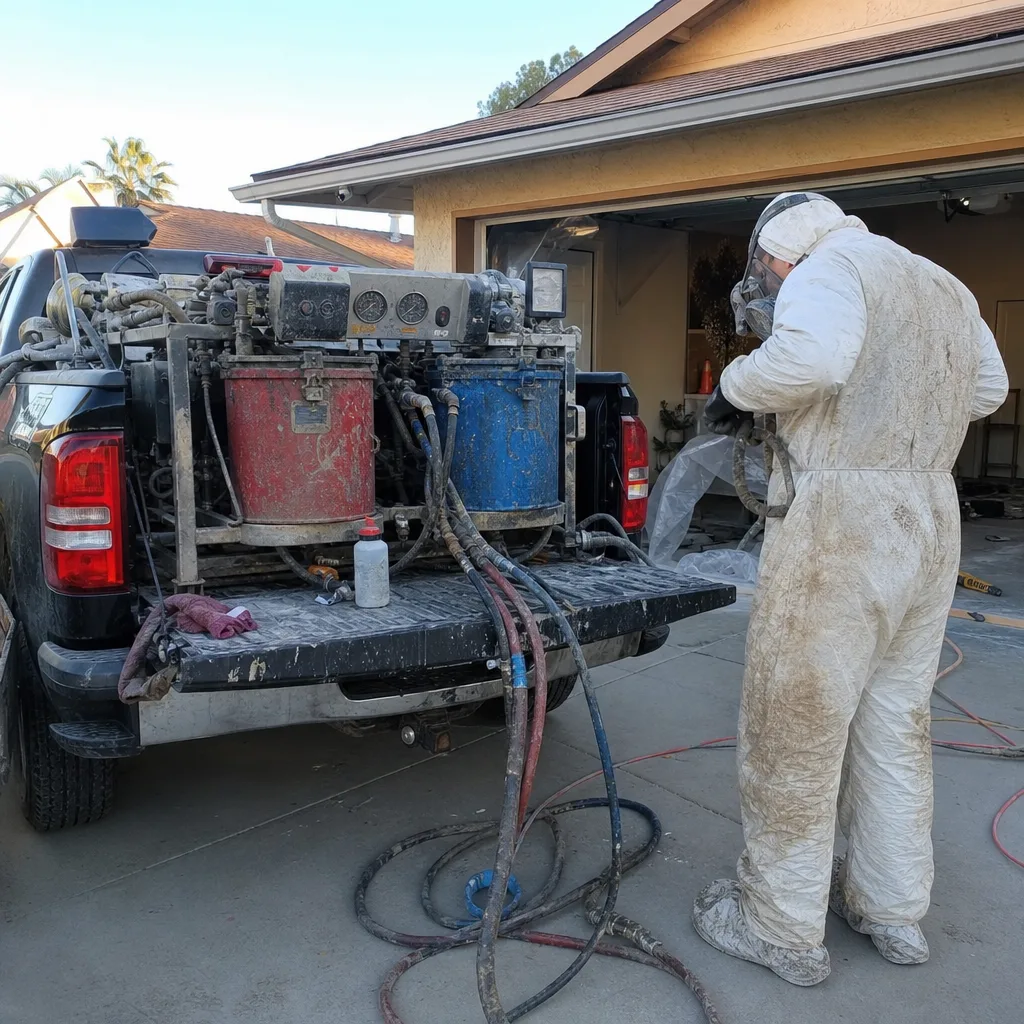
Trusted Spray Foam Insulation for Orange County Homeowners
If you’re wondering how much Spray Foam Insulation costs, Orange County prices typically run $2.50 to $6.50 per square foot installed, and it’s the most effective way to stop the heat that turns attics into ovens by July. We’ve been installing it here since 2002, and the difference it makes in a South County summer or a Santa Ana wind event is immediate. Garrett Sloane leads our Orange County team, and every job starts the same way: you get a written price before any work begins, and you know the name and face of the technician before they knock. That matters in a county where door-to-door scams are common and trust is earned, not assumed. Call (559) 249-4794 any time, day or night. A live person answers.
Closed Cell Spray Foam Insulation
Closed Cell Spray Foam Insulation is a dense, rigid foam that expands to roughly 30 times its liquid volume and hardens into a moisture-resistant barrier with an R-value around R-6.5 to R-7 per inch. We recommend it for Orange County homes where crawl spaces flood, rim joists wick moisture, or homeowners want structural reinforcement along with insulation. Aspen Attic Insulation Orange County installs closed cell foam in attics, crawl spaces, rim joists, and garage ceilings, typically at $3.50 to $6.50 per square foot depending on depth and access. Garrett and his crew check the substrate temperature and moisture level before spraying, because closed cell foam won’t bond properly to a damp or cold surface, and a failed bond is a warranty claim waiting to happen.
Moisture Barrier Properties
Closed cell foam acts as a Class II vapor retarder at 1.5 inches, which means it stops water vapor from moving through walls into your attic. That’s why we use it in coastal areas like Laguna Beach and Newport Beach, where marine air pushes humidity into framing cavities year-round.
In crawl spaces, closed cell foam on the subfloor stops the damp-earth smell that rises into living areas. It also keeps rodents from gnawing through, which is a real concern in the foothill neighborhoods around North Tustin.
Structural Strength Add-On
Closed cell foam adds shear strength to wall assemblies, roughly doubling racking resistance when sprayed at 2 to 3 inches in standard 2×4 framing. We’ve used it on older homes in Costa Mesa and Placentia where the studs are fine but the wall could use stiffening.
This is a genuine benefit in earthquake country. It isn’t a substitute for seismic retrofitting, but it does make a wall feel more solid under load.
Open Cell Spray Foam
Open Cell Spray Foam is a lighter, softer foam that expands dramatically and fills cavities completely, delivering about R-3.5 per inch and acting as an air barrier even at partial fills. It’s the right choice for Orange County attics where the goal is stopping air movement first and adding R-value second. Our team at Aspen Attic Insulation Orange County installs open cell foam primarily in vented and unvented attic assemblies, typically at $2.50 to $4.50 per square foot for standard depths. The material uses water as a blowing agent, so there’s no lingering chemical off-gassing after the foam cures, which matters when you have kids sleeping in bedrooms directly below the attic.
Air Sealing First
Open cell foam’s real job is stopping air leaks. In an Irvine tract home from the 1980s, the recessed lights, top plates, and plumbing chases in the ceiling can leak as much air as an open window. Foam seals all of it in one pass.
We see attic temperatures drop 30 to 40 degrees in August after open cell foam goes in. That translates directly to lower AC runtime and more even bedroom temperatures at night.
Sound Dampening
Because open cell foam stays soft and porous, it absorbs sound instead of reflecting it. Homeowners near John Wayne Airport flight paths or busy corridors in Tustin and Costa Mesa notice quieter bedrooms after we spray the underside of the roof deck.
It’s not marketed as acoustic foam, but the effect is real. We’ve had clients tell us they stopped noticing the 6 a.m. garbage truck after their attic was foamed.
Spray Foam Insulation Contractors
Spray Foam Insulation Contractors are licensed insulation specialists who apply expanding foam in attics, walls, floors, and crawl spaces rather than blowing or batting fiber material. In Orange County, you want a contractor who understands that foam chemistry changes with heat, humidity, and surface temperature, and who won’t cut corners on prep work. Aspen Attic Insulation Orange County has been running foam crews since 2002, and every technician who shows up is background-checked, identity-verified, photo-badged, and wearing a clean marked uniform. You get the tech’s name and photo before the visit. If anyone else shows up at your door, the visit is free and we make it right. That’s the Threshold Standard, and it’s non-negotiable.
What Separates a Good Foam Contractor
A good foam contractor will inspect your attic or crawl space before quoting, not just measure square footage and send a text. Our crews check for old wiring, recessed light clearances, venting configuration, and moisture problems before we ever mix a barrel of foam.
We also pull back existing insulation by hand before spraying in most attics. You can’t spray foam over blown-in fiberglass and expect it to adhere to the drywall, which is a shortcut some low-bid crews take.
Written Price, Written Guarantee
Every spray foam job we quote comes with a written price delivered before any work starts. No post-job surprises, no “we found something extra” add-ons. The number on the quote is the number on the invoice.
That job is then covered by our 365-Day Done Right Promise. If the foam isn’t done right, we make it right, in writing, covering labor and materials, for a full year. A free second visit if the repair fails.
Spray Foam Attic Insulation
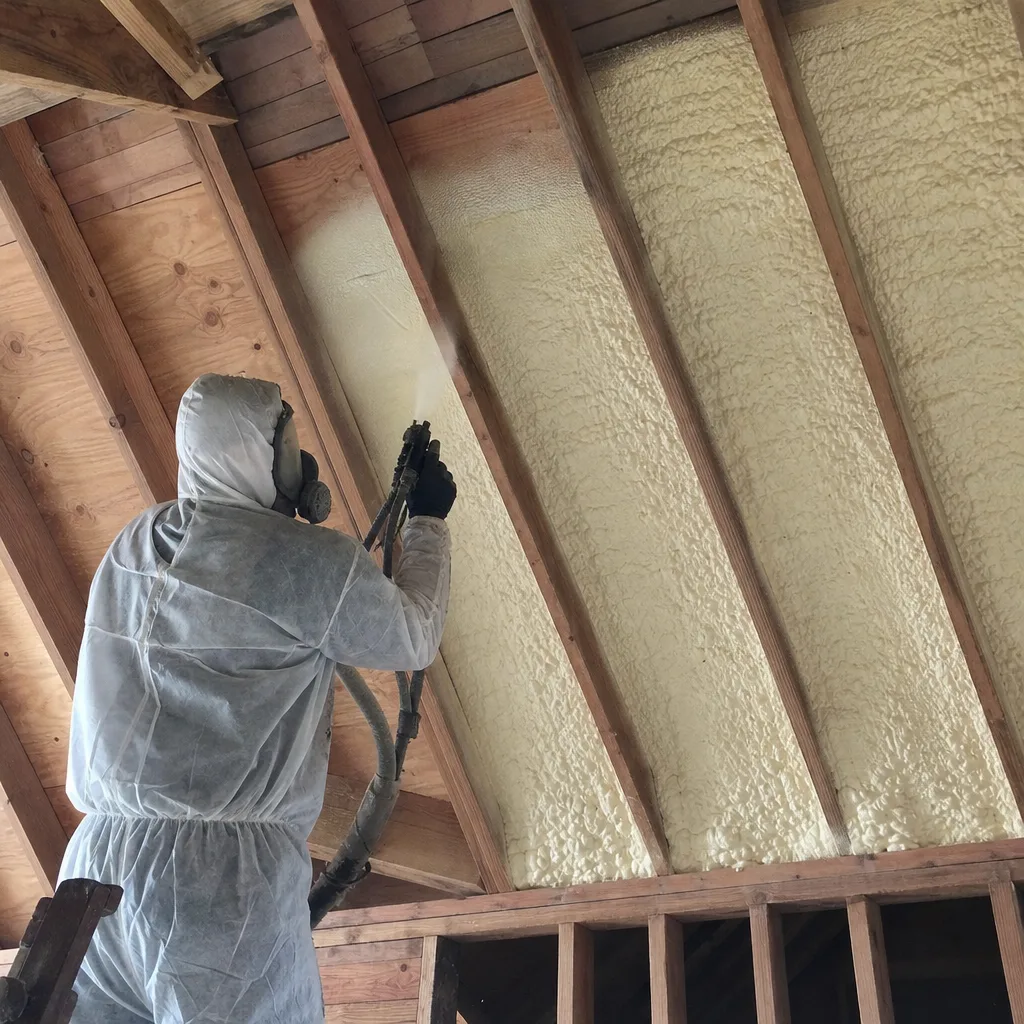
Spray Foam Attic Insulation is the application of expanding foam to the underside of the roof deck or the attic floor to stop heat transfer and air leakage through the attic space. In Orange County, where attic temperatures routinely hit 140 degrees in summer, spray foam attic insulation is the single biggest lever you can pull for home comfort. Our crews at Aspen Attic Insulation Orange County handle both vented attic floor applications and unvented hot-roof installations, with costs ranging from $3,500 to $9,000 for a typical 1,500 to 2,000 square foot attic depending on foam type and depth. We’ll tell you which approach fits your house, and we’ll put it in writing before we start.
Vented vs. Unvented
A vented attic keeps soffit and ridge vents in place, and we spray foam on the attic floor to seal ceiling penetrations and add R-value. This is the lower-cost option and works well in most Orange County homes built before 2000.
An unvented attic, also called a hot roof, means spraying foam directly on the underside of the roof deck and sealing the vents. This brings the HVAC system and ductwork inside the conditioned envelope, which is a big deal when your ducts run through the attic.
Ductwork in the Attic
Most Orange County homes have ducts in the attic, and those ducts lose 20 to 30 percent of conditioned air to the hot attic before it ever reaches a bedroom. Foaming the roof deck puts those ducts inside a semi-conditioned space, and that’s where the real energy savings come from.
We’ve had clients in Irvine and Tustin report 30 to 40 percent reductions in summer cooling bills after a hot-roof conversion. The foam pays for itself faster than most people expect.
Spray Foam Wall Insulation
Spray Foam Wall Insulation is injected or sprayed foam that fills wall cavities during construction, renovation, or retrofit to create an air-tight, high-R-value barrier between living space and outside air. We install it in new construction walls in Orange County, in open stud bays during remodels in Aliso Viejo and Laguna Niguel, and as injection foam in existing closed walls where batt insulation has settled or failed. Expect to pay $2.50 to $5.50 per square foot of wall area depending on whether the wall is open or closed and which foam chemistry we use. Our crew at Aspen Attic Insulation Orange County handles all of it, and we always check for knob-and-tube wiring before any closed-wall injection, because spray foam over live knob-and-tube is a fire hazard.
New Construction and Remodels
When walls are open during a remodel, spraying foam is the best time to do it. The stud bays are exposed, the electrical and plumbing rough-in is visible, and our techs can cover every gap before drywall goes up.
In new construction, closed cell foam in exterior walls gives you R-21 to R-28 in a 2×6 cavity, plus the air sealing that fiberglass batts simply cannot provide. It’s a premium product, but it’s the difference between a tight house and a leaky one.
Retrofit Injection Foam
For existing homes with hollow walls, we can inject slow-rise foam through small holes drilled in the drywall or stucco. The foam expands gently and fills voids without bowing the wall, and we patch the holes afterward.
This is popular in older Orange County neighborhoods like Placentia and downtown Orange, where homes from the 1950s and 60s often have no wall insulation at all. The difference in summer wall temperature is immediately noticeable to the touch.
Rim Joist Spray Foam
Rim Joist Spray Foam is the sealing and insulation of the band board where the floor framing meets the foundation wall, one of the leakiest and most overlooked points in any Orange County home. The rim joist is the board that sits on top of the foundation, and in most houses it’s just wood with no insulation at all, leaking air at every floor level. Sealing it with closed cell foam stops stack-effect air movement, blocks rodent entry, and keeps crawl space air from pulling into the house. We charge $1,500 to $3,500 for a typical two-story rim joist package, depending on linear footage and access. It’s one of the highest-ROI insulation jobs we do for Costa Mesa and Irvine homeowners.
Air Leakage and Stack Effect
Warm air rises and escapes through the upper floors, which pulls replacement air in through the lower floors. In Orange County, that replacement air often comes from a damp, musty crawl space. Foaming the rim joist cuts that exchange off at the source.
We use closed cell foam at the rim joist because it handles moisture and adds rigidity. In homes near the coast in Laguna Beach and San Juan Capistrano, it also stops the salt-air corrosion that eats at exposed framing.
Rodent and Pest Exclusion
Rim joists are the number one entry point for mice and roof rats in Orange County. Foam seals the gaps between the sill plate and foundation, and rodents can’t chew through closed cell foam the way they can through fiberglass or cardboard baffles.
We’ve had clients in North Tustin and Tustin hills who called us for insulation and ended up solving a rodent problem they’d been fighting for years. The foam closed the door, literally.
Crawl Space Spray Foam Insulation
Crawl Space Spray Foam Insulation is the application of expanding foam to the subfloor or crawl space walls to create a thermal and moisture break between the crawl space and the home above. In Orange County, crawl spaces run the range from clean and dry to standing-water disasters after winter rains, and foam is the only insulation that doesn’t collapse when it gets wet. We install closed cell foam on crawl space ceilings and walls for $3.00 to $6.00 per square foot, depending on access height and whether we’re sealing the vents. Aspen Attic Insulation Orange County crews spend a lot of time in Orange County crawl spaces, and we’ll tell you honestly if you need a vapor barrier or drainage work before insulation goes in.
Subfloor vs. Encapsulation
Subfloor insulation means spraying foam on the underside of the floor above the crawl space. It keeps floors warmer in winter and stops cold air from wicking up through the floorboards, which is a common complaint in older Newport Beach and Costa Mesa homes on raised foundations.
Encapsulation is different, and it means foaming the crawl space walls and sealing the vents to turn the crawl space into a conditioned space. It’s a bigger job but it solves humidity, mold, and floor comfort in one pass.
Moisture and Mold Control
Open crawl space vents let humid coastal air pour in every night, and when that moist air hits a cold slab or cold pipes, it condenses. That’s why so many Orange County crawl spaces smell like a cave. Foam on the walls stops that condensation cycle.
We won’t foam over active leaks or standing water. If we find a drainage problem, we’ll flag it and recommend a fix before we insulate, because insulation over a water problem makes it worse.
Garage Spray Foam Insulation
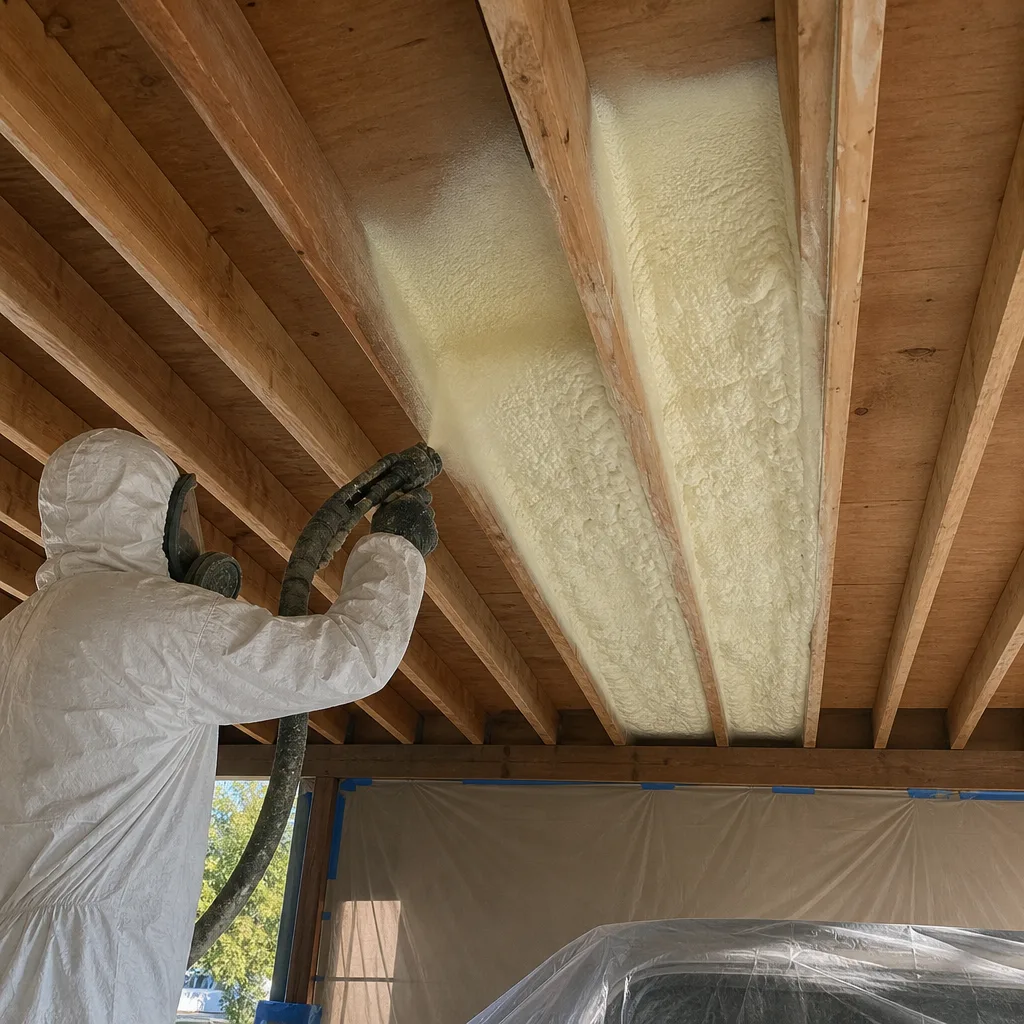
Garage Spray Foam Insulation is the application of foam to the garage ceiling and walls to stop the heat that turns a garage into an oven and radiates up into the bedrooms above it. In Orange County, where many homes have bonus rooms or master suites over the garage, this is one of the most commonly requested insulation upgrades we do. We charge $2,500 to $5,500 for a standard two-car garage ceiling and wall package, with open cell foam as the usual choice for garages that aren’t exposed to direct moisture. The room above the garage is always the hottest room in the house, and foaming the garage ceiling fixes it. Garages with living space above are a natural fit; our page on home insulation covers the broader picture.
Bonus Room Comfort
The floor over a garage has no conditioned air underneath it, which is why those rooms are 8 to 10 degrees hotter than the rest of the house in summer. Spray foam under that floor, in the garage ceiling joists, changes the heat transfer equation completely.
We’ve done dozens of these in Irvine and Tustin tract homes, and clients consistently tell us the bonus room finally feels like part of the house. This is also a spot where open cell foam outperforms fiberglass batts because it seals the gaps between joists that batts leave exposed.
Wall and Door Gaps
Garage walls often have gaps where the framing meets the slab, and the big garage door itself leaks air around the perimeter. We foam the walls and rim, and while we can’t insulate a garage door itself, we can replace the weatherstripping and point you to a garage door company if the door needs work.
The air sealing matters more than most people think. A garage that shares a wall with living space leaks conditioned air through that shared wall, and foaming the garage side stops it.
Brands We Service
We install and work with spray foam systems from Icynene and Demilec, two of the most proven names in closed and open cell foam chemistry, and they don’t fail when they’re applied correctly. Icynene’s open cell product, in particular, has a long track record in hot-climate attics, which is exactly the load an Orange County roof deck sees every summer. Our crews are trained on the specific temperature and humidity windows for each product, and we stock the OEM spray tips and hose heaters those systems need to run clean.
For batt and blown-in complement work, we also carry Owens Corning and John Manville products, and we’ll use them where fiberglass makes more sense than foam, like in some vented attics on a budget. Whether you have an existing foam system that needs a patch or repair, or you’re starting fresh, we can help. If we don’t know the product that’s currently in your attic, we’ll take a core sample and match it before we quote, because mixing incompatible foam chemistries is a fast way to get a failed bond.
Signs You Need a Pro Right Now
- Bedrooms over the garage or attic that run 10 degrees hotter than the rest of the house. That’s a heat-transfer problem through the ceiling or floor cavity. Spray foam in the right location stops it at the source, and waiting through another Orange County summer just means another season of paying to cool a room that won’t hold temperature.
- Dust, musty air, or a crawl space smell coming up through the floors. Air is moving from your crawl space into your living space, and that air carries whatever is in the crawl space. Foam on the subfloor or crawl space walls stops that exchange, and the smell goes with it.
- Visible gaps around rim joists in the garage or crawl space, or daylight showing at the sill plate. Those gaps are air leaks and pest highways. Closed cell foam at the rim joist closes them permanently in one pass.
- Ice water running out of your AC ducts in the attic or condensation on the attic side of the ceiling. Hot attic air meeting cold ductwork causes condensation, and condensation in fiberglass turns into mold. Foam the roof deck or the duct chase, and the condensation stops because the temperature difference stops being extreme.
- Your energy bill went up 20% or more year over year with no change in usage. That’s usually an air leakage problem that has gotten worse, often from settled insulation or new gaps around penetrations. A foam seal and top-up will bring it back down.
Our Process, Step by Step
- 1
Call and talk to a person. You call (559) 249-4794 and a live person answers. We ask about the rooms that are uncomfortable, what you’ve tried, and what your utility bill looks like. We book a visit at a time that works for you, and we confirm the technician’s name and photo before they arrive.
- 2
We inspect the space, not just the square footage. The tech shows up in a clean marked uniform with a photo ID badge, and they go into the attic, crawl space, or garage with a thermal imaging camera and a moisture meter. We look at venting, wiring, plumbing, and framing condition before we recommend anything.
- 3
You get a written price before any work starts. We don’t give verbal ranges and then change them later. The quote is line-itemed, in writing, and it includes the foam type, depth, square footage, and total price. No deposit pressure, no “sign today” discount.
- 4
We prep and spray with the right equipment. On installation day, we mask and cover surfaces, pull back old insulation where needed, and run our foam rig at the manufacturer’s specified temperature and pressure. We spray in lifts to the correct depth, not one thick pass that can crack or shrink.
- 5
We walk the job with you and hand you the written guarantee. You inspect the foam with the tech before they leave. Then you get the 365-Day Done Right Promise in writing, covering labor and materials, with a free second visit if anything fails within the year.
How Much Does Spray Foam Insulation Cost in Orange County?
A typical spray foam insulation job in Orange County runs $3,000 to $9,000 depending on what area of the home you’re insulating and which foam type you choose. Open cell foam in a 1,500 square foot attic runs $3,500 to $5,500 on the low end. Closed cell foam on a rim joist package runs $1,500 to $3,500. A full crawl space encapsulation with closed cell foam runs $5,000 to $12,000 depending on access and whether a vapor barrier and vent sealing are included. Wall injection foam in an existing 1,500 square foot home runs $4,000 to $8,000. The biggest cost drivers in Orange County are square footage, the depth of foam specified, whether the space is open or closed, and access conditions like low crawl spaces or steep roof pitches. The cheapest quote in Orange County usually means a crew that doesn’t prep surfaces correctly or uses whatever foam happens to be on the truck. Overpaying is just as easy to avoid: get a line-item quote, ask what foam chemistry is specified, and ask whether the quote includes prep, masking, and cleanup. Our free estimate includes all of that in writing, matched to the actual space you have, not a generic square-footage formula. Call (559) 249-4794 and we’ll send a tech with a name, a face, and a written price.
Our Service Area Near Orange County
We service all of Orange County and the surrounding cities, from Irvine, Orange, and Tustin to Costa Mesa, Newport Beach, and Laguna Beach. Our crews are in Placentia, North Tustin, and Laguna Niguel weekly, and we run calls out to Aliso Viejo and San Juan Capistrano on a regular schedule. For homes in coastal communities where salt air and humidity make moisture control a bigger concern, we plan extra prep time into the quote up front. If you’re in the Irvine area, see our dedicated page on Spray Foam Insulation in Irvine for details specific to your neighborhoods, or Spray Foam Insulation in Orange if you’re closer to the Plaza. Most of our Orange County jobs run 2 to 5 days from first call to finished install, and same-week scheduling is common outside of peak summer.
Serving Orange County, CA - Our Local Coverage Area
We’re based in the Orange County area and know this community well. Use the map below to see our service coverage - if you’re nearby, we can almost certainly help.
Frequently Asked Questions About Spray Foam Insulation in Orange County
Spray foam insulation is a liquid plastic that expands into a solid foam when sprayed, creating an air seal and an insulating layer in a single application. It comes in two main forms: open cell, which is soft and air-permeable, and closed cell, which is rigid and moisture-resistant. In Orange County, it’s most commonly used in attics, crawl spaces, rim joists, and garage ceilings to stop air movement and heat gain. See our main Spray Foam Insulation in Orange County guide for the full breakdown.
Most residential spray foam jobs in Orange County take one to two days from start to finish. An attic spray for a typical 1,500 to 2,000 square foot home takes about 4 to 6 hours of actual spray time, plus prep and cleanup. Crawl space and rim joist work usually finishes in a single day, and foam is fully cured and safe to be around within 24 hours.
Spray foam insulation in Orange County typically runs $2.50 to $6.50 per square foot installed, with most whole-attic jobs landing between $3,000 and $9,000. The price depends on foam type, depth, square footage, and access conditions. A full crawl space encapsulation or whole-home wall injection runs higher, typically $5,000 to $12,000. Call (559) 249-4794 for an exact quote, our estimates are free and written.
Yes, we service and repair existing Icynene and Demilec spray foam systems throughout Orange County. We’ll take a core sample of the existing foam to identify the chemistry before we quote any repair or addition. Mixing incompatible foam types can cause adhesion failure, so matching the existing product is a required step we never skip.
Yes. A live person answers our phones 24/7 at (559) 249-4794, and we offer same-day emergency response for storm damage, pest intrusion, or failed insulation that’s letting water into the home. If you’ve had a roof leak or a broken pipe and the insulation is soaked, we’ll get a tech out with a name and photo before they arrive.
Our 365-Day Done Right Promise covers labor and materials in writing for a full year on every spray foam job. If the foam fails, cracks, shrinks, or doesn’t perform, we make it right at no charge. The guarantee includes a free second visit if a repair fails, which means we don’t get to walk away from a job that isn’t done correctly.
For attics, clear access to the attic hatch and move any stored items away from the spray area if you can. For crawl space or garage work, clear a path to the access door and the work area. We handle the rest, masking, covering, cleanup, and disposal of old insulation, and we’ll walk you through everything before the tech starts spraying.
Schedule Your Spray Foam Insulation Service in Orange County Today
You’ll know the price before we start, and you’ll know the technician’s name and face before they knock. Call (559) 249-4794 for a free, no-obligation estimate on spray foam insulation in Orange County. We answer 24/7, and every job carries our 365-Day Done Right Promise in writing.
Written by Garrett Sloane, Owner at Aspen Attic Insulation Orange County, serving Orange County since 2002.