
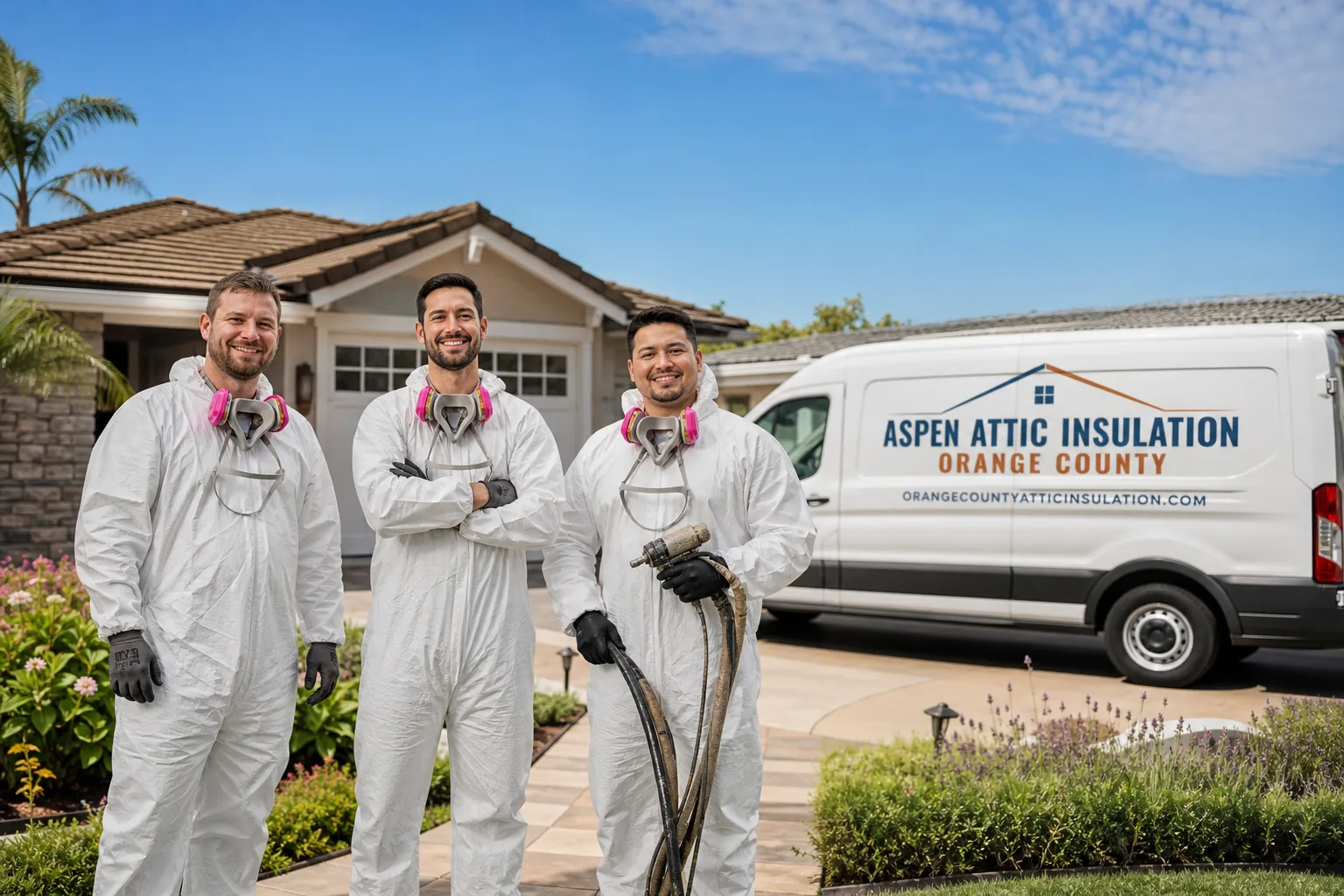
Fast, Reliable Spray Foam Insulation Across San Juan Capistrano
Spray foam insulation in San Juan Capistrano typically costs between $2.50 and $7.00 per board foot installed, depending on whether you need open-cell or closed-cell foam. Most attic applications in this city run $3,800 to $9,500 total. The good news: these older adobe and Spanish Revival homes, plus the salt air that eats at everything, mean San Juan Capistrano homeowners see faster comfort and energy payback than almost anywhere else in Orange County. If you’re losing cool air through your attic or walls, call Aspen Attic Insulation Orange County at (559) 249-4794 for a written price before any work starts.
Why Aspen Attic Insulation Orange County Is San Juan Capistrano’s Preferred Spray Foam Insulation Company
We’ve worked on enough homes off Camino Capistrano and Del Obispo Street to know that no two attics here are alike. A 1930s Spanish Colonial near the Los Rios District has entirely different needs than a 1970s ranch up in the hills. Our Spray Foam Insulation team has crawled through both, and we know which foam chemistry holds up in each.
Every technician who arrives at your door in San Juan Capistrano is background-checked and identity-verified under the Threshold Standard. You’ll get the tech’s name and photo sent to you before the visit. When they knock, they’ll have a photo ID badge on a clean marked uniform. If anyone else shows up, the visit is free and we make it right. That’s not marketing language. It’s our protocol, every visit, every time.
We answer the phone with a live person 24/7. No voicemail loops. And before any foam is sprayed, you get a written price. No post-job surprises, no “we found something else.” The 365-Day Done Right Promise covers labor and materials in writing for a full year. If the repair fails, the second visit is free.
Open Cell Spray Foam in San Juan Capistrano
Open cell spray foam in San Juan Capistrano costs $2.50 to $4.50 per board foot installed, and it’s typically the right choice for interior walls and attic floors where you want air sealing and sound dampening without the higher cost of closed-cell. It expands to roughly 100 times its liquid volume, filling irregular adobe voids, old plaster gaps, and the odd framing of 1920s homes better than any batt ever could.
In San Juan Capistrano’s warmer inland microclimate, open-cell foam does the heavy lifting on air sealing. The city sits about 4 miles from the coast, which means summer highs regularly climb into the 80s and 90s°F even when Laguna Beach stays cool. That temperature gap means your air conditioner runs longer, and every gap in your attic floor or wall cavity is a leak you’re paying to cool.
Attic floor air sealing
The most common application we do in San Juan Capistrano is open-cell foam on the attic floor. It stops the stack effect where hot attic air gets pulled into the living space and conditioned air escapes upward. In a 1960s ranch with original batt insulation, this single application often cuts cooling bills by 20 to 30 percent within the first summer.
We typically pair it with air sealing around can lights, plumbing penetrations, and the attic hatch. Those small gaps add up fast in older homes.
Wall cavity injection
For homes with existing wall cavities, we drill small access holes and inject open-cell foam to fill what the original builder left empty. This works well in the 1960s and 70s ranch-style homes scattered across San Juan Capistrano, where many were built with minimal or no wall insulation. The foam conforms to the cavity without sagging over time, which is a common failure in older blow-in installations.
Spray Foam Insulation Contractors in San Juan Capistrano
Spray foam insulation contractors in San Juan Capistrano should understand that this city is not one housing type. It’s adobe, plaster, stucco, wood frame, and everything in between. Our crew has worked on all of it, and the difference shows in how we prep, where we apply vapor barriers, and which foam we recommend. Closed-cell spray foam in San Juan Capistrano runs $4.50 to $7.00 per board foot installed, and it’s the only option for applications where moisture resistance and structural rigidity matter.
Hiring us means the job gets quoted in writing before anything is sprayed. The technician who shows up is the technician whose name and photo you already have. We don’t send subs. We don’t send whoever happens to be free. We send the person we told you we’d send.
Roof deck and ceiling applications
Closed-cell foam on the underside of the roof deck creates a conditioned attic, which is a major win in San Juan Capistrano where summer attic temperatures can exceed 130°F. It keeps your ductwork in a sealed, semi-conditioned space instead of a superheated oven, which means your AC doesn’t have to work as hard to deliver cool air through the vents.
This application is especially relevant for homes in the Los Rios Historic District and other older neighborhoods where adding soffit and ridge vents would compromise original rooflines. Closed-cell foam air-seals the deck without changing the exterior appearance at all.
Rim joist encapsulation
In homes with crawl spaces, the rim joist is a major air and moisture leak point. We spray closed-cell foam around the entire perimeter to seal it. In San Juan Capistrano’s salt air environment, this also helps protect the framing from rising ground moisture and the humid air that gets pulled in through vented crawl spaces.
Trusted Brands We Service in San Juan Capistrano
We stock and service spray foam from Johns Manville, Knauf, and Demilec, plus the open-cell Icynene line. Having multiple brands on hand matters here because different homes need different chemistry. A 1930s adobe with thick plaster walls needs an injectable open-cell product that can conform to irregular cavities. A 1990s Mediterranean custom build with a tile roof and conventional framing may do better with a closed-cell Demilec application against the sheathing. We match the product to the home, not to what’s sitting in the warehouse. And because we keep materials staged for San Juan Capistrano jobs, turnaround from estimate to completion is typically under a week.
Common Spray Foam Insulation Problems We See in San Juan Capistrano Homes
- Salt air corrosion on spray foam equipment and adhesion. San Juan Capistrano’s proximity to the coast means salt-laden air gets into everything, including spray foam gun tips and proportioner fittings. When those components corrode, the foam comes out off-ratio, which leads to poor adhesion on exposed roof decks. We inspect and maintain our rigs specifically for coastal conditions, and we check adhesion before leaving every job.
- Moisture wicking in adobe and early plaster walls. The 2-foot-thick adobe walls common in the Los Rios District wick ground moisture upward. If you inject open-cell foam into those walls without a vapor barrier, the foam holds that humidity and loses R-value over time. We address this with the right barrier and the right foam choice before any injection.
- Trapped roof heat in 1960s and 70s ranch homes. Many of these homes have minimal attic ventilation. If closed-cell foam is applied directly against the roof sheathing without accounting for the existing venting, heat gets trapped against the shingles during San Juan Capistrano’s 80 to 90°F summers, which accelerates shingle deterioration. We check venting first and adjust the application accordingly.
- Deteriorated batt insulation in older homes. Homes built before the 1980s often have batt insulation that has settled to 2 inches or less, offering almost no R-value. In a 1920s Spanish Colonial off Camino Capistrano, that means the attic is basically uninsulated. Spray foam solves this permanently because it doesn’t settle, sag, or lose its air-sealing properties over decades.
Pricing for Spray Foam Insulation in San Juan Capistrano, CA
Open-cell spray foam in San Juan Capistrano runs $2.50 to $4.50 per board foot installed. Closed-cell runs $4.50 to $7.00 per board foot. A typical attic floor application in a 1,500 to 2,000 square foot home lands between $3,800 and $7,200. Roof deck applications run higher because they cover more surface area and require closed-cell chemistry: expect $7,500 to $14,000 for a full roof deck in this city. What affects the price most is access, the condition of the existing insulation, and whether we need to remove settled batts first. Every estimate is free, and you get the exact written price before anything is sprayed. Call (559) 249-4794 and you’ll talk to a live person who can schedule your estimate.
We Also Serve Cities Near San Juan Capistrano
Aspen Attic Insulation Orange County serves San Juan Capistrano and the surrounding communities, including Laguna Niguel, Aliso Viejo, Laguna Beach, and Laguna Woods. If you’re in one of those cities and dealing with the same coastal humidity and aging housing stock, the same team, the same written pricing, and the same 365-Day Done Right Promise apply. Call (559) 249-4794 and ask for an estimate anywhere in the area.
Serving San Juan Capistrano, CA - Our Local Coverage Area
We’re based in the San Juan Capistrano area and know this community well. Use the map below to see our service coverage - if you’re nearby, we can almost certainly help.
FAQs About Spray Foam Insulation in San Juan Capistrano
Yes. The foam is applied from inside the attic, against the underside of the roof sheathing. The clay tiles on the exterior are never touched. For historic adobe homes, we recommend closed-cell foam because it air-seals the roof deck without requiring exterior modifications, preserving the original roofline and tile. The application creates a conditioned attic that stays within a few degrees of the living space, which protects both the structure and the historic materials from extreme heat swings.
Not directly. Adobe walls have no stud cavities to fill. Instead, we inject open-cell foam through small 1-inch holes drilled into the interior plaster, letting it expand into the irregular voids within the adobe. This requires a vapor barrier on the interior side because adobe wicks ground moisture. Without that barrier, open-cell foam retains humidity and loses R-value. Done correctly, this technique insulates the wall without adding exterior bulk or disturbing the historic plaster.
Salt-laden air corrodes the application equipment first. When proportioner fittings and gun tips corrode, the two chemical components don’t mix at the correct ratio, which produces off-ratio foam with poor adhesion. That foam can peel away from the substrate within months. We maintain our equipment specifically for coastal conditions, and we check adhesion on every garage ceiling before we leave. If the bond isn’t right, the job isn’t done.
For wall cavities in a 1970s ranch, open-cell foam typically makes more sense. It’s less expensive at $2.50 to $4.50 per board foot, it expands to fill the cavity completely, and it provides excellent air sealing. Closed-cell is overkill for most wall cavity applications unless you need the added moisture resistance. For the attic floor, open-cell is also our standard recommendation. For a roof deck, closed-cell is the better choice because of its higher R-value per inch and moisture resistance.
Yes, in most cases. Interior insulation work that does not alter the exterior appearance, roofline, or visible historic fabric typically falls outside the scope of a historic review. Spray foam applied from inside the attic leaves no exterior change. That said, the rules can vary by specific property and any existing historic easements. We’re familiar with the district’s constraints and can advise you on what your particular home requires before any work begins. Call (559) 249-4794 and we’ll walk through it with you.
What San Juan Capistrano’s Salt Air, Adobe Walls, and Historic Rules Mean for Your Insulation
Here’s what no generic insulation website will tell you: San Juan Capistrano is not just another Orange County city. The Los Rios Historic District has the oldest continuously occupied neighborhood in California, with adobe walls up to 2 feet thick and no stud cavities. You can’t just spray foam into a wall that has no cavity. Instead, the work requires exterior rigid foam or cavity injection through small drill holes. It’s a technique local insulators know, but it’s uncommon anywhere else in the county.
The salt air changes equipment maintenance and foam chemistry. It degrades spray gun tips and proportioner fittings faster than inland. If your contractor isn’t accounting for that, you get off-ratio foam and a failed application. We account for it because we’ve seen it happen here.
Our crew recently upgraded a 1930s Spanish Colonial Revival home off Camino Capistrano near the Los Rios District. The attic had only 2 inches of settled Rockwool batts, and the adobe walls had no cavity for conventional spray foam. We installed Demilec closed-cell spray foam on the underside of the roof deck to create a conditioned attic, then drilled 1-inch holes in the interior plaster and injected Icynene open-cell foam into the adobe’s irregular voids. The result was a 40 percent reduction in cooling runtime during the summer’s 90°F afternoons, without disturbing the historic plaster or adding exterior bulk.
That’s the standard we bring to every home in San Juan Capistrano, whether it’s a 1920s adobe, a 1970s ranch, or a 2000s Mediterranean build. You get a written price before work starts. You get the technician’s name and photo before they arrive. You get the 365-Day Done Right Promise in writing, covering labor and materials, with a free second visit if anything fails. Call (559) 249-4794 today and talk to a live person.
Written by Garrett Sloane, Owner at Aspen Attic Insulation Orange County, serving San Juan Capistrano since 2002.