
Demilec Vapor Barrier Installation: The Orange County Owner’s Guide
We stock and install Demilec-compatible vapor barrier systems throughout Orange County, with typical installed pricing running $2.75 to $4.50 per square foot depending on access, existing insulation condition, and whether the Demilec spray foam needs repair work first. Most Orange County homes we see are back to full vapor protection within a single day once we’re on site. Homeowners usually discover the failure when they notice warmer attic air, musty smells in upstairs rooms, or see condensation staining around ceiling penetrations. The vapor barrier is the layer between your conditioned air and the underside of your roofline, and when it stops doing its job, your AC starts working against warmer, wetter air moving through the house.
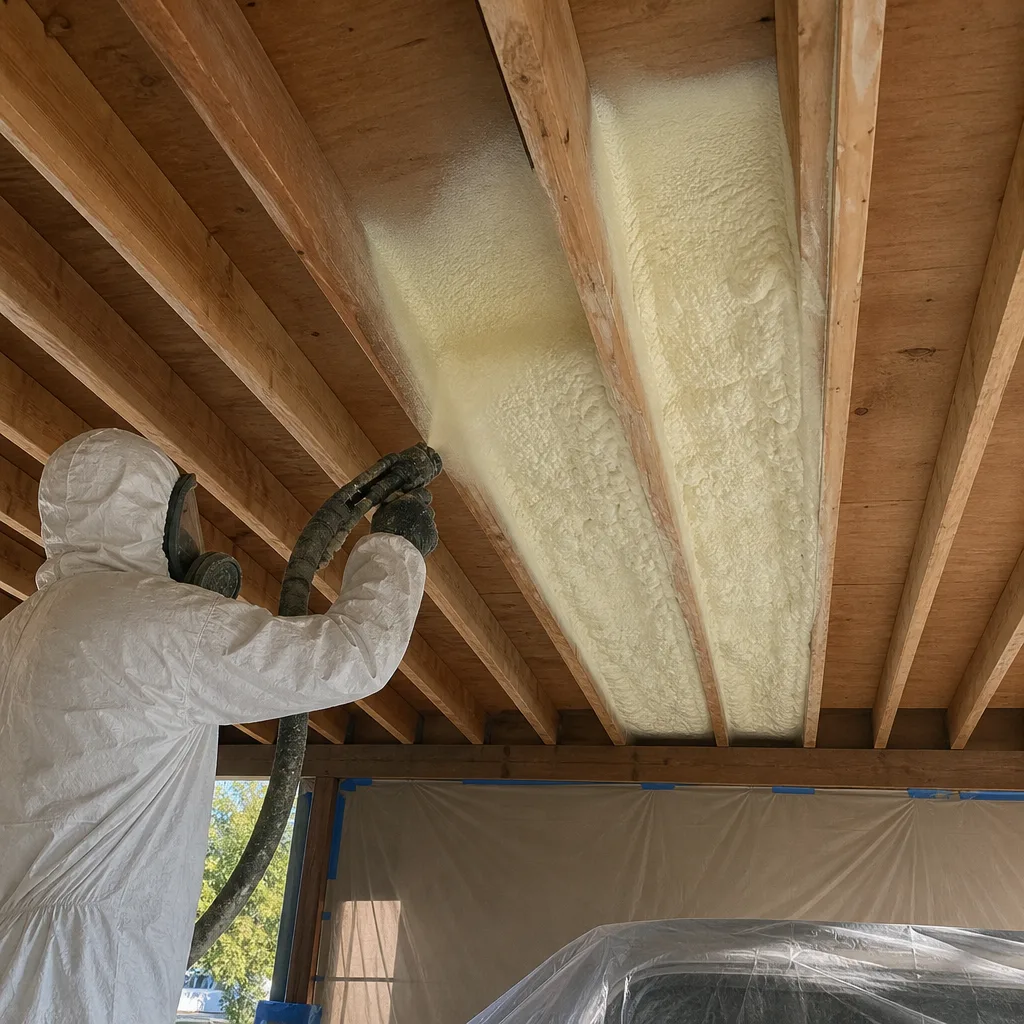
If your attic is working against you, your AC never wins. That’s the whole story with vapor barriers in Southern California humidity cycles.
Key Takeaways
- Installed Demilec vapor barrier pricing in Orange County runs $2.75 – $4.50 per square foot in most homes we assess.
- We carry Demilec and Demilec-compatible barrier materials on our trucks for same-day installation in most Orange County cities.
- We send the technician’s name and photo before the visit so you know exactly who is walking up to your door.
- Every install carries our 365-Day Done Right Promise in writing, covering labor and materials for a full year.
Which Demilec Models This Applies To
Demilec makes several spray foam and vapor barrier product lines, and the installation details shift depending on which one your attic has. The Heatlok HFO series, the Sealection 500, and the older Sealection Agribalance are the three we see most often across Orange County homes. Heatlok HFO is a closed-cell foam that acts as its own vapor barrier when applied to the right thickness, typically two to three inches on the underside of the roof deck. Sealection 500 is an open-cell product that needs a separate vapor barrier layer, and that’s where most failures happen. The barrier separates from the foam, tears at seams, or gets punctured during other attic work.
Here’s the compatibility gotcha that catches a lot of Orange County homeowners: you can’t just slap any vapor barrier over any Demilec product. Open-cell foam breathes, which means the barrier has to be a specific perm-rated membrane designed to work with that breathability. If you install a zero-perm barrier over Sealection 500, you trap moisture inside the foam and create a mold-friendly situation that no homeowner wants. We check the Demilec product label, verify the foam type and thickness, then match the barrier material to the spec. We’re an independent installer, not affiliated with Demilec directly, but we carry OE and OE-equivalent barrier materials that match Demilec’s published install specs.
Signs Your Demilec Vapor Barrier Installation Is Failing
A failed vapor barrier rarely announces itself with a bang. It’s usually a slow fade that shows up as small clues you might dismiss as normal house quirks. Here are the five patterns we see most often on inspection calls across Orange County, from Santa Ana attics to Laguna Niguel hillside homes:
- Condensation stains around ceiling lights or vents. Water vapor is moving through the ceiling plane and condensing on the cooler fixture surfaces. This means the barrier above has a tear, a pulled seam, or was never fully sealed around a penetration. In coastal Orange County cities with higher humidity, this shows up fast.
- Musty smell in upstairs rooms, stronger in summer. Old open-cell foam against a failed barrier starts holding moisture. The smell is the moisture interacting with dust, framing lumber, and old insulation. It’s not always mold, but it’s the early warning sign that mold conditions are forming.
- Peeling paint or bubbling drywall texture on the ceiling. When vapor pushes through, the drywall absorbs it and the finish fails. This is more common in older Orange County homes where the drywall was not sealed before the Demilec install.
- Rising cooling bills without a change in usage. If the barrier is compromised, your AC is now conditioning air that’s mixing with hotter, wetter attic air. The system runs longer to hit the same set point. We’ve seen bills jump 15 to 20 percent before the homeowner figures out why.
- Visible sagging or detached barrier material in the attic. Sometimes the failure is obvious if you look. Barrier sheets pull away from staples or adhesive due to heat cycling, and in Orange County’s summer attic temperatures, that cycle is brutal on cheaper aftermarket products. If you can see it hanging, it’s already been failing for months.
Replacement Cost & What’s Included
For a typical Orange County attic, you’re looking at $2.75 to $4.50 per square foot installed. A 1,200-square-foot attic space usually lands between $3,300 and $5,400, depending on access, how much old barrier material needs removal, and whether the existing Demilec foam is in good enough shape to stay in place. We give you the written price before any work starts, and that number does not move unless we both agree on a change order in writing first.
What’s included: removal and disposal of failed barrier material, inspection and local repair of any damaged Demilec foam, new barrier installation to Demilec’s spec for your foam type, sealing around all penetrations including lights, vents, and junction boxes, and a full written work summary when the job is done. Every install is covered by our 365-Day Done Right Promise, in writing. If the barrier fails within a year, we come back and fix it free.
DIY or Call Us?
Here’s the honest split. You can absolutely do a visual inspection of your vapor barrier yourself and we encourage it. A flashlight and five minutes in the attic will tell you if the barrier is visibly sagging, torn, or pulling away at seams. What you should not do is attempt a full barrier replacement on a Demilec foam assembly. The reason is simple: matching the wrong barrier perm rating to open-cell foam creates a moisture trap that becomes a five-figure mold problem long before you notice it. The same goes for spray-applied barriers. Getting the thickness wrong or missing a penetration seal undoes the entire job in one July afternoon.
If you want to inspect, do it. If you find the failure, call us at (559) 249-4794. We’ll send a tech with the right barrier material already on the truck, and you’ll have that tech’s name and photo before he pulls into your driveway.
How Long Does a Demilec Vapor Barrier Last in Orange County?
A properly installed vapor barrier over Demilec foam should last 15 to 20 years in Orange County’s climate, but cheaper aftermarket membranes can fail in five to seven years because our summer attic heat cycles soften the material and break down the adhesive. The real lifespan killer is poor installation, not the product. Missed penetration seals and pulled seams fail within the first two years no matter how good the material is.
Can the Existing Vapor Barrier Be Repaired Instead of Replaced?
Sometimes, yes. If the failure is a single tear or a pulled seam in an otherwise intact barrier, a patch with matching material and proper sealing tape can solve it. But if the barrier is brittle, sagging in multiple places, or peeled away from the foam across more than about 15 percent of the surface, replacement is the honest answer. We’ll tell you which one applies to your attic and show you why. Garrett Sloane has built his crew’s reputation on telling homeowners when work is not needed, and the same honesty applies here.
How Long Does the Installation Take?
Most Orange County vapor barrier replacements take four to six hours on site. Larger attics, complicated rooflines, or extensive Demilec foam repair can push into a full day. We carry barrier material, sealants, and replacement foam on our trucks, so we rarely need a second visit. You’ll have a written price before work starts, and the job finishes in one trip unless we tell you otherwise up front.
Do You Stock Demilec-Compatible Vapor Barrier Materials?
Yes. Our trucks carry Demilec-spec barrier membranes, sealing tape, and foam repair materials, along with products from seven other major brands including Owens Corning, Johns Manville, and Rockwool, plus Reflectix for specific retrofit situations. The right material goes in based on your Demilec product, not just whatever happens to be on the shelf. If your attic needs a different match, we’ll tell you and get it rather than forcing the wrong product into your roof deck.
If you’re seeing any of the failure signs above or just want someone who knows Demilec products to take an honest look, call us at (559) 249-4794. A live person answers, you get a written price before any work starts, and the technician who shows up is the one whose name and photo we already sent you.
Written by Garrett Sloane, Owner, Aspen Attic Insulation Orange County at Aspen Attic Insulation Orange County, serving Orange County and nearby areas.