
Demilec Attic Insulation: The Orange County Owner’s Guide
If you’ve got Demilec spray foam or Demilec blown-in insulation in your attic and it’s underperforming, flaking, pulling away from the rafters, or leaving you with cold spots and higher bills, we can help. As an independent Orange County insulation contractor, we stock Demilec-compatible materials and install them for between $1.80 and $4.50 per square foot, with most full attics in Orange County running $3,200 to $8,600 installed, and we can usually have a tech out same-day. You’ll typically notice the problem first as a room that won’t hold temperature, a spike in your Edison bill during summer, or visible gaps in the foam you can see from the attic hatch.
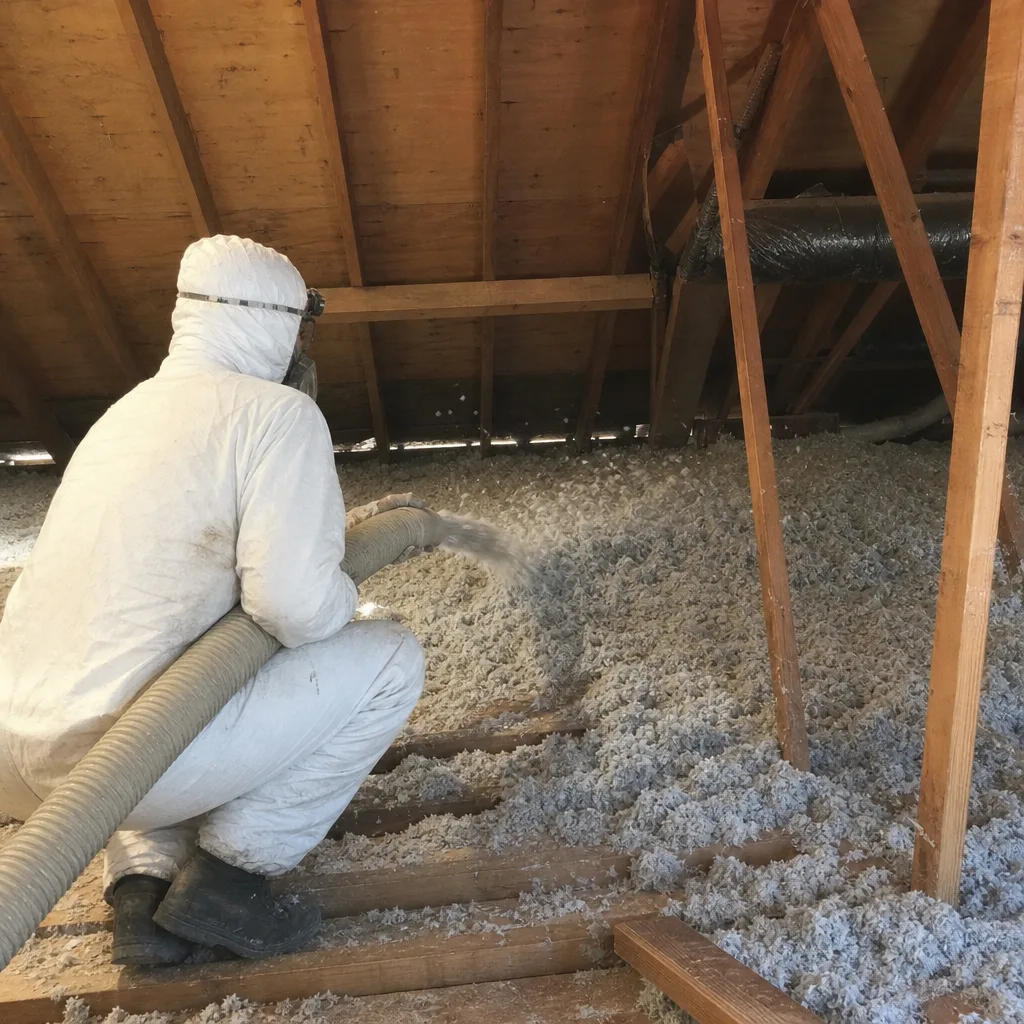
Here’s something we tell every Orange County homeowner who calls us about Demilec: this is a good product line, but like any insulation, it fails when it’s installed wrong or when the attic environment works against it. We see it all over the county, from older Mission Viejo homes where the original open-cell foam has started to shrink, to newer Irvine builds where the builder sprayed too thin and the homeowner never knew until the first August heat wave. If your attic is working against you, your AC never wins.
Which Demilec Models This Applies To
Demilec makes two product families that matter for attics: the Heatlok HFO line (closed-cell spray foam) and the Sealection 500 line (open-cell spray foam). Both come in two-component kits and are applied with a spray rig, not poured or rolled. If you’re pulling back the hatch and trying to identify what you have, open-cell Sealection looks like a soft, off-white or light-yellow sponge with a slightly rough surface. Closed-cell Heatlok is denser, usually cream-colored, and sounds solid when you knock on it. Neither should be flaking into dust or peeling away in sheets.
Here’s a compatibility gotcha every Orange County owner should know: you cannot patch Demilec with just any spray foam from the home center. Canned foam isn’t rated for the same thermal and fire performance, and layering a different chemistry over Demilec can trap moisture between the two layers. In our coastal Orange County climates, that trapped moisture is how you end up with mold you can’t see. We use Demilec-matched materials when the job calls for factory-spec compatibility, and we also stock quality equivalents from our other brands, including Reflectix for radiant barrier applications, when the right product doesn’t have to carry the Demilec name to do the job right. The honest answer: for patch and repair work, OEM-matching matters more than for a full re-insulation, where the name on the drum matters less than the mil thickness and R-value per inch.
To identify your exact product, look for the label on the attic access or on the foam itself near the eaves. Demilec stamps batch codes and product names on the cans and kits, and that code tells us exactly what you have and what we need to match it. If you can’t find it, we can identify it visually and with a quick density test during the estimate.
Signs Your Demilec Attic Insulation Is Failing
Not every attic problem screams at you. Here are the five signs we see most often in Orange County, and what each one actually means.
- Uneven ceiling temperatures from room to room. The foam has pulled back from the rafters or settled, leaving gaps you can’t see from below. One bedroom bakes in August while the hallway stays cool.
- Higher summer or winter bills for the same thermostat setting. Your AC is running longer because the attic isn’t holding the thermal boundary it used to. In Orange County’s inland heat, an attic that loses even a few degrees of performance costs you real money every month.
- Foam that flakes, powders, or crumbles when touched. This is UV degradation or a bad chemical mix on install day. Either way, the material’s R-value has dropped well below its original spec, and it’s not coming back.
- Visible gaps or shrinkage around the attic hatch, vents, and the roofline. Spray foam shrinks over time, especially open-cell in hot, dry attics. A quarter-inch gap around a rafter bay is a thermal leak, full stop.
- A musty or chemical smell that won’t dissipate. Off-gassing can indicate improper ratio mixing during the original spray, and mustiness usually means moisture is getting into the foam. Both are worth a professional look, and both are fixable.
Replacement Cost & What’s Included
For Orange County attics, Demilec-compatible spray foam replacement runs $1.80 to $4.50 per square foot installed, depending on whether you’re doing a full re-spray or a targeted repair. Most full attic jobs fall between $3,200 and $8,600. A smaller patch job, like sealing the hatch surround or filling rafter gaps, can run $400 to $1,200. Here’s the breakdown:
- Full re-foam of an average 1,800 sq ft attic: $5,800 to $8,600 for closed-cell, $3,200 to $5,400 for open-cell
- Partial patch or gap-fill: $400 to $1,200, including materials and labor
- Removal of damaged or failed foam: $1 to $3 per square foot, depending on accessibility
What’s included in our price: the written quote before any work starts, the materials, the labor, removal and disposal of old failed material when needed, and the 365-Day Done Right Promise. That’s our guarantee in writing covering both labor and materials for a full year. If the repair fails or the problem comes back, we return and do the second visit free. No deductions, no fine print, no “that part isn’t covered.” Our pricing in Orange County is upfront, itemized, and handed to you before we spray a single inch of foam.
DIY or Call Us?
There are things you can do yourself, and things where you’ll wish you’d called someone. Here’s the honest split.
You can absolutely measure the depth of your existing insulation, take photos of visible gap lines or flaking foam, and check your attic hatch weatherstripping for gaps. Those observations help us quote you accurately, and they’ll help you understand what we’re looking at when we walk the attic. What you should not do is buy a home center spray foam kit and start patching. Demilec two-component foam requires mixing equipment, proper PPE, and knowledge of how the chemicals react at different ambient temperatures. In an Orange County attic in July, you’re working in 120-degree heat with chemicals that expand aggressively. Get the mix ratio wrong and you’ve got a sticky, toxic mess that costs more to remove than it would have cost to have us do it right the first time. The same goes for removing old foam, cutting into roof decking, or rewiring anything near the foam. Some jobs are just not homeowner jobs.
If you’re in Orange County and you’d rather have it done by a crew that shows up with a name, a photo, and a written price, call us at (559) 249-4794. We’ll tell you if your attic actually needs work, and we’ll tell you if it doesn’t. Garrett Sloane has been saying that to homeowners for years, and it’s the same thing he’ll tell you.
FAQs
Demilec open-cell spray foam typically lasts 25 to 35 years in Orange County attics, and closed-cell can last 50 years or more, provided it was mixed and cured correctly on install day. The biggest lifespan threats here are UV exposure, extreme attic heat cycling, and moisture intrusion from roof leaks. If your foam is flaking or shrinking before the 10-year mark, the install was the problem, not the product. Call (559) 249-4794 and we’ll inspect it and give you a written assessment.
Yes, in most cases a targeted repair works fine. We can remove just the failed section, prep the area, and re-spray with a Demilec-matched product that bonds properly to the existing foam. Full replacement only makes sense when a significant portion of the attic has failed, or when the original install was too thin across the entire roof deck. We’ll show you what we’re seeing before we recommend anything.
For a typical single-family Orange County attic, the job takes one day from start to finish, including setup, spraying, and cleanup. Larger homes or attics with extensive failed material to remove can take two days. We’ll give you the timeline in writing before any work starts.
We stock Demilec-compatible materials and maintain inventory from all eight of our house brands, including Demilec and Reflectix, on our Orange County trucks. For most patch and repair jobs, the product we need is already on the truck when the tech pulls up. For larger re-sprays, we bring the full kit set on the scheduled day. Call (559) 249-4794 for a free estimate and we’ll tell you exactly what we’re bringing and why.
Written by Garrett Sloane, Owner, Aspen Attic Insulation Orange County at Aspen Attic Insulation Orange County, serving Orange County and nearby areas.