
Last updated October 16, 2026
DIY vs Professional Insulation: The Orange County Homeowner’s Decision Guide
Here’s the number that surprises most Orange County homeowners: renting a blower machine and buying enough fiberglass to cover a 1,200-square-foot attic costs roughly $400 at Home Depot. A professional job runs between $1,400 and $2,200. On paper, DIY saves you a thousand dollars. But that math quietly assumes you’ll also air-seal every can light, top plate, and plumbing penetration first, and most DIYers skip the step that accounts for 40% of the energy benefit. This guide walks through the real decision, including the attic conditions that make DIY genuinely risky and the one scenario where doing it yourself makes clear sense. For how to hire a insulation contractor in Orange County, see our step-by-step guide.
Quick Answer
DIY attic insulation in Orange County makes sense only when you’re adding depth to existing, sound insulation in an easy-access attic with no air sealing needed and no wiring or vermiculite concerns. For everything else, a professional job costs more upfront but pays for itself through proper air sealing, code compliance, and avoiding costly moisture and heat problems that a bad DIY job can create. The deciding factor is rarely cost alone. It’s attic access, attic wiring, and whether air sealing gets done correctly before any insulation goes in.
Table of Contents
- The Real Cost Breakdown: DIY vs Professional in Orange County
- The Step Everyone Forgets: Air Sealing Before Insulation
- The Three Attic Conditions That Disqualify DIY
- Title 24 and Rebates: What a DIY Job Can’t Get You
- The Labor Reality: Working in a 130°F Orange County Attic
- When DIY Makes Sense: The Single Scenario
- Common Mistakes to Avoid
- When to Call a Professional
- Frequently Asked Questions
- The Bottom Line
The Real Cost Breakdown: DIY vs Professional in Orange County
Let’s put real numbers on the table. For a typical 1,200-square-foot Orange County attic with a target depth of R-38 fiberglass or R-30 blown-in cellulose, here’s what you’re looking at.
- DIY materials (blower rental included): $380 to $520. This covers roughly 20 to 24 bags of GreenFiber blown-in cellulose or Owens Corning fiberglass, plus a 4-hour blower rental. You’ll also need a respirator, goggles, and knee boards.
- DIY with air sealing materials added: $520 to $700. Cans of spray foam, caulk, weatherstripping for the attic hatch, and foil tape add up faster than most people expect.
- Professional blown-in insulation with full air sealing: $1,400 to $2,200. This typically includes removal of old, compressed material if needed, air sealing, and the insulation itself.
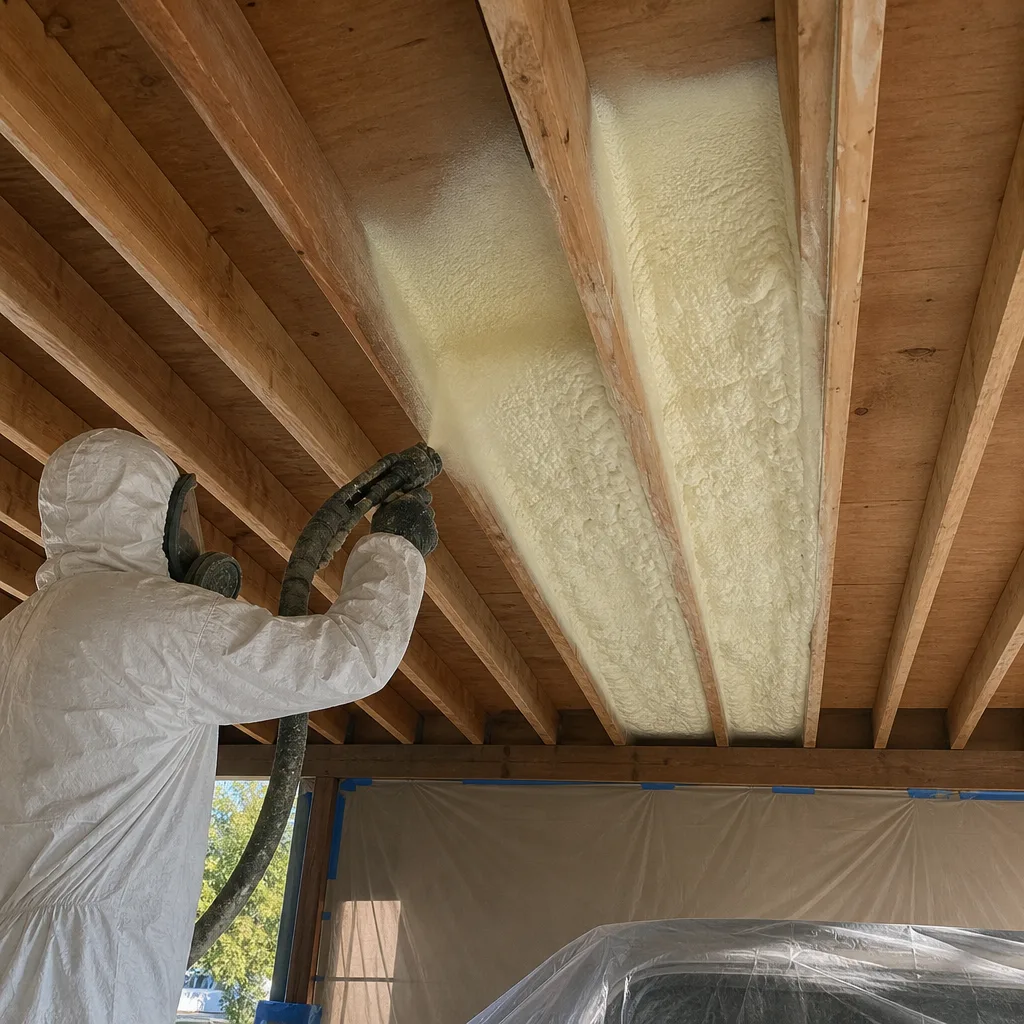
- Professional spray foam insulation: $2,500 to $5,500 for a full attic, depending on open-cell versus closed-cell and roof pitch.
What the DIY number doesn’t capture is the cost of a second trip back up if the first attempt doesn’t get the depth right. Fiberglass loses its R-value dramatically when installed too densely or when gaps are missed. A homeowner who under-insulates a 200-square-foot section because they ran out of bags midday has a permanently underperforming attic until they go back and fix it, which means another rental, another batch of bags, and another afternoon.
We’ve also seen cases where a well-intentioned homeowner blocked soffit vents with baffle-less insulation, trapped moisture in the attic, and ended up with mold remediation quotes that exceeded the original professional insulation estimate by a factor of three. In Orange County’s coastal humidity bands, that trapped moisture accelerates fast, especially in older wood-framed homes near Huntington Beach, Seal Beach, and Costa Mesa.
When you look at the online price guides, remember those are national averages. Orange County’s material costs are not materially higher than the national average, but labor is. Skilled, background-checked, insured attic crews are in short supply in Southern California, and that’s part of why professional work sits at the higher end of the national range here. The other reason is that Orange County has one of the highest concentrations of pre-1980 construction in the state, and older homes almost always need more prep work before insulation can go in correctly.
The Step Everyone Forgets: Air Sealing Before Insulation
If there’s one piece of this guide to read twice, it’s this one. Insulation slows heat transfer through the attic floor. Air sealing stops conditioned air from leaking out of your living space entirely. They are two different jobs, and air sealing must happen first.
Think of it this way. Insulation is the sweater. Air sealing is the zipper. A thick sweater with the zipper left open doesn’t keep you warm, and that’s exactly what happens when a homeowner blows 14 inches of fiberglass over an unsealed attic floor. The warm air from the house below rises through every crack around every ceiling light, every electrical box, every top plate where interior walls meet the ceiling, and every plumbing vent. That air moves straight through the insulation as if the insulation weren’t there, because fiberglass and cellulose are designed to trap still air, not moving air.
In our experience running attic insulation jobs across Orange County, air sealing accounts for roughly 40% of the total energy benefit of a proper insulation job. That’s not a marketing number. The Department of Energy’s own literature identifies air leakage as the single largest source of heat loss in most American homes, and Orange County homes built before the 1980s are often exceptionally leaky because older construction practices paid little attention to penetrations.
What does air sealing actually involve? Here’s the honest list.
- Pulling back or removing old insulation to expose the attic floor.
- Sealing every recessed can light with a rated cover or, if the fixture isn’t IC-rated, replacing it first.
- Foaming around every ceiling electrical box and every wire penetration.
- Foaming the top plates, the horizontal framing where interior walls meet the attic floor.
- Caulking or foaming around plumbing vents and any chase that runs from the living space into the attic.
- Weatherstripping and insulating the attic hatch or pull-down stair.
This is the work that separates a high-performance insulation job from one that looks right from the hatch but underperforms for the next 20 years. And it’s the step most DIYers skip, not because they’re lazy, but because no one told them it existed.
The Three Attic Conditions That Disqualify DIY
Before you rent a blower, you need to walk your attic. Not peek through the hatch. Walk it, with a good light, and check for three specific conditions. Any one of these should stop a DIY project in its tracks.
1. Knob-and-Tube Wiring
Knob-and-tube wiring is still present in a meaningful number of pre-1960 homes in Anaheim, Santa Ana, Fullerton, and Orange. The porcelain knobs and tubes carry live current along exposed conductors running through open attic framing. Blowing insulation over knob-and-tube is a genuine fire hazard. The National Electrical Code prohibits insulating over or around active knob-and-tube wiring in most configurations, because the insulation traps heat that the old open-air system depended on dissipating. A DIYer who doesn’t recognize knob-and-tube can create a serious safety risk in an afternoon. A licensed insulation contractor will identify the wiring, flag it, and coordinate with an electrician before any insulation goes in.
2. Asbestos Vermiculite
Vermiculite insulation mined before 1990, particularly from the Libby, Montana mine, often contained asbestos. It looks like small, shiny, accordion-textured pebbles, gray-brown or silver-gold. If your attic contains vermiculite, do not disturb it. Disturbing it releases fibers into the air, and that’s a one-way ticket to expensive abatement. A professional will test it first. If it’s positive for asbestos, the job changes completely, and it’s a job no homeowner should attempt.
3. Attic Heights Under 30 Inches
Some Orange County homes, especially mid-century ranches and certain tract developments in Garden Grove and Westminster, have attic clearances that barely clear the collar ties. Working in a 24-inch attic space means lying flat on your stomach on joists while trying to maneuver a heavy blower hose. It’s physically punishing, it takes three times as long, and the likelihood of missing sections is high. Professional crews use slim-profile hoses, extension wands, and advance planning to get complete coverage in low attics. A DIYer in a 24-inch attic is usually a DIYer who gives up halfway and quietly lives with a half-insulated house.
Title 24 and Rebates: What a DIY Job Can’t Get You
Insulation permits, codes & inspections in CA apply to all insulation work in Orange County regardless of whether the work is done by a homeowner or a contractor. But the documentation requirement is where DIYers hit a wall.
Southern California Edison and SoCalGas both offer insulation rebate programs for qualifying upgrades. Here’s the catch: to claim those rebates, the installation must be documented by a licensed contractor who files a certificate of installation verifying the R-value achieved, the square footage covered, and that the work meets current code requirements. A homeowner cannot self-certify. A DIY job cannot qualify for SCE or SoCalGas rebates. Period.
Typical attic insulation rebates in Orange County run from $0.10 to $0.25 per square foot depending on the program year and whether air sealing is included. On a 1,200-square-foot attic, that’s $120 to $300 in rebate money a DIYer leaves on the table. Combined with the fact that a professional job includes air sealing and a written guarantee, the true cost gap narrows further than the raw materials number suggests.
There’s also the matter of resale. Orange County home sales routinely include disclosure of insulation work. A buyer’s inspector who finds non-compliant DIY insulation, unsealed penetrations, or insulation over knob-and-tube will flag it. The seller then either fixes it before close or takes a price concession. We’ve seen both play out in escrow, and the fix-before-close invoice is always higher than the original professional quote would have been.
The Labor Reality: Working in a 130°F Orange County Attic
Let’s talk honestly about what it’s like to work in an attic in Orange County in the summer. From June through October, attic temperatures in Anaheim, Irvine, Santa Ana, and inland communities routinely reach 120 to 140 degrees Fahrenheit by midday. Even in the spring and fall, a closed attic on a sunny day will hit 100 to 110 degrees by 10 a.m.
A DIY attic insulation job for a 1,200-square-foot attic takes a reasonably fit homeowner 8 to 12 hours including setup, air sealing, blowing, and cleanup. That’s a full weekend day, much of it spent in a kneeling or crouched position, wearing a respirator, in heat that will soak your shirt through in the first 20 minutes. Dehydration, exhaustion, and heat stress are real risks. So is losing your balance on a joist in a dark, dusty attic with 16 inches of loose fill below you.
Professional crews do this work in 3 to 4 hours. They arrive with a two-person team, one running the hopper outside and one working the hose in the attic. They start early, work fast, and are conditioned to the physical demands. They also know how to position the hose to get even depth without packing the material too tightly, which is the single most common DIY error we see when we come in to correct a homeowner’s first attempt.
We’ve corrected DIY jobs in Mission Viejo, Lake Forest, and Yorba Linda where the homeowner did the work in August, underestimated the heat, rushed the final third of the attic, and left a 300-square-foot section at less than half the target depth. The fix required adding material, which is less expensive than a full redo, but it was still a second trip, a second rental, and a second afternoon in a hot attic. The time cost alone defeats the savings.
When DIY Makes Sense: The Single Scenario
Now let’s be fair. There is one situation where doing it yourself is genuinely reasonable, and we’ll tell you exactly how to verify you’re in it.
The scenario: you have an existing attic with sound, dry, undisturbed insulation that’s simply too shallow. You need to add depth, not fix a problem. The attic has walkable access, headroom of at least 36 inches, no knob-and-tube, no vermiculite, and you’re not touching the air sealing because it was either done before or the attic is already performing reasonably well.
Before you rent the blower, here’s the verification checklist.
- Check the existing insulation for moisture. Press your hand into it in several spots. If it feels damp or you see water stains on the kraft paper or on the joists, stop and call a professional. Adding insulation over a moisture problem makes it worse.
- Confirm the wiring. Look for porcelain knobs and cloth-covered wire. If you see either, stop. Call an electrician first.
- Check the depth. Use a yardstick to measure the existing insulation in at least eight different locations. If the depth varies by more than 2 inches, you have an uneven base that will telegraph through your new layer.
- Look for rodent activity. Rat droppings, nesting material, or chewed wiring in an Orange County attic means you have a pest problem that needs solving before you bury evidence of it under 10 inches of new insulation.
- Verify the attic hatch is sealed. If air is leaking around the hatch, adding insulation above it won’t fix the leak. You’ll need to weatherstrip and insulate the hatch panel first.
If all five checks pass, adding blown-in fiberglass or cellulose on top of existing insulation is a legitimate DIY project. We recommend Owens Corning AttiCat or GreenFiber blown-in products with a machine rental from any Orange County Home Depot or Lowe’s. Expect to spend 5 to 7 hours including setup and cleanup, and do it in the early morning before the attic heats up.
And if you’d rather not spend a weekend in the attic, professional blown-in insulation work in Orange County typically costs between $1,400 and $2,200, includes air sealing, and is done in an afternoon.
Common Mistakes to Avoid
- Skipping air sealing entirely. This is the big one. Blowing insulation over an unsealed attic floor cuts the effective R-value dramatically and leaves you with a house that still loses conditioned air. Seal first, insulate second.
- Blocking soffit vents. Your attic needs airflow. Piling insulation over the soffit vents traps moisture and rots the roof decking. Use baffles, also called vent chutes, at every soffit opening before blowing.
- Insulating over knob-and-tube wiring. This is a fire hazard, full stop. Pre-1960 homes in Anaheim, Santa Ana, and Fullerton are the highest-risk category in Orange County. If you see porcelain knobs, stop.
- Compressing fiberglass or cellulose to “fit more in.” Insulation works by trapping air. Squeezing it down defeats the purpose. Never compress it to close a hatch or fit under a low beam.
- Ignoring recessed lights that aren’t IC-rated. Non-IC-rated recessed lights need a 3-inch clearance from insulation or a rated cover. Burying them in insulation creates a fire risk. Older Orange County homes with original can lights are common offenders.
- Blowing insulation into a moisture-damaged attic. If there’s a roof leak, a bathroom fan venting into the attic, or condensation, fix the moisture source first. Insulation holds moisture against wood, and that’s how mold starts.
- Underestimating the physical toll. A 130-degree attic is not a weekend project venue. If you have any uncertainty about heat tolerance, balance, or stamina, the professional quote is the cheaper option.
When to Call a Professional
Call a professional if your attic has knob-and-tube wiring, vermiculite that could contain asbestos, moisture damage, rodent activity, or headroom under 30 inches. Call if you want the SCE or SoCalGas rebates, which require contractor documentation. Call if you want air sealing done correctly, because it’s the step that delivers 40% of the energy benefit and it requires skill to do without creating new problems. Call if you’re in a two-story Orange County home where the attic access is a ceiling hatch above a stairwell and maneuvering a 40-pound hose in that space is genuinely dangerous. Aspen Attic Insulation Orange County home offers free estimates throughout Orange County. Call (559) 249-4794 and a live person answers.
Frequently Asked Questions
DIY materials cost $380 to $520 for a typical 1,200-square-foot attic, while professional work runs $1,400 to $2,200, but the professional job includes air sealing, code compliance, and rebate eligibility that DIY can’t match. Explore more guides & resources to compare your options. In Orange County, the effective savings shrink once you account for skipped air sealing and lost SCE/SoCalGas rebates. Call (559) 249-4794 for a free written estimate and we’ll show you the real number for your attic.
Professional blown-in attic insulation in Orange County typically costs $1,400 to $2,200 for a 1,200-square-foot attic including air sealing, while spray foam runs $2,500 to $5,500 depending on the roof assembly. The range varies by existing insulation depth, attic access, wiring conditions, and whether old material needs removal. We give a written price before any work starts, and the estimate is free.
Yes, a professional crew typically completes a standard Orange County attic insulation job in 3 to 4 hours with a two-person team, while a DIY job usually takes 8 to 12 hours including setup and cleanup. Professionals arrive early, work in the heat efficiently, and get even coverage in a fraction of the time. We run jobs in Orange County daily and most are done before lunch.
DIY insulation isn’t automatically disqualified, but non-compliant work flagged by a buyer’s home inspector commonly results in a fix-before-close demand or a price concession during escrow, which is a real cost Orange County sellers face. A contractor-installed job with a written guarantee and documented R-value is easier to defend in a disclosure package. Professional attic insulation in Orange County includes exactly that documentation.
Blown-in cellulose and fiberglass perform well in Orange County’s climate, while spray foam provides the best air sealing and is preferred for homes with ductwork in the attic, which many mid-century Orange County homes have. The right choice depends on your attic assembly, not a one-size-fits-all chart. We carry Owens Corning, Johns Manville, Knauf, and GreenFiber products and match the material to the specific attic, not the truck inventory.
Check for knob-and-tube wiring in pre-1960 homes, especially in Anaheim and Santa Ana, look for vermiculite that may contain asbestos, assess moisture and rodent activity, measure existing insulation depth, and confirm soffit vents aren’t blocked before adding any new material. Any one of the first three conditions means the job belongs to a professional who can handle it safely. If you’re not sure what you’re looking at, our technicians do free attic evaluations across Orange County.
Most Orange County homeowners recover the cost of professional attic insulation in 3 to 5 years through lower cooling and heating bills, with summer AC savings being the largest contributor in the inland cities. Coastal homes recover it more slowly because they run heat less and rely on ocean breezes, but they still benefit from reduced summer humidity intrusion. The exact payback depends on your current R-value, air sealing condition, and HVAC usage patterns.
The Bottom Line
The DIY-versus-professional insulation decision in Orange County isn’t really a cost decision. If your attic is clean, dry, walkable, and already air-sealed, adding depth yourself is defensible and we’ve told you exactly how to verify that. But air sealing is the step that delivers 40% of the job’s value, knob-and-tube and vermiculite are dealbreakers you must not touch, and Title 24 rebates require a contractor’s certification. Most Orange County homes, especially the pre-1980 stock that dominates Anaheim, Santa Ana, Garden Grove, and Fullerton, need the full professional treatment. Spray foam options add another professional-only layer for homes with attic ductwork. The written price and the 365-day guarantee remove the two things homeowners legitimately fear: surprise bills and wrong work. Call (559) 249-4794 and we’ll give you a free written estimate, along with the name and photo of the technician who will show up at your door.
Written by Garrett Sloane, Owner at Aspen Attic Insulation Orange County, serving Orange County since 2002.